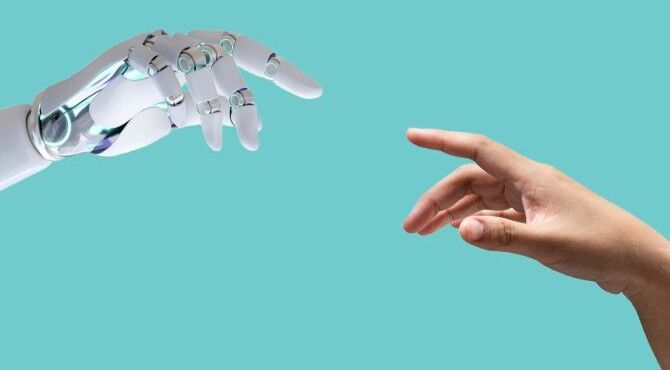
What technology can and cannot replace - the human factor that drives performance
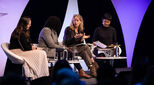
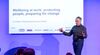
What role do humans play in the age of Artificial Intelligence and automation, and what skills do they have which will never be replaced by machines? In her speech to the CIPD conference, Wendy Harris, VP of EMEA at Rippling, a California-based software company, discussed what technology can replace, and what it cannot.
3 December 2025

View your copy of the Winter 2025/26 issue of Think Global People magazine
Click on the cover to access the digital edition.
Wendy Harris, VP of EMEA, Rippling

Humans are not machines – getting the balance wrong
To illustrate the difference between the operating abilities of human and machine, Harris opened with a personal story about the brutal working hours expected of a trader at Goldman Sachs, the investment firm. As a trader, her working environment was built on speed, pressure and precision. She worked 12 hour days, had nine trading screens, and was immersed in a culture of constant vigilance. She also described the moment her body forced a reckoning.“I used to get up at 4:30am every single day and started work at 6am,” she said. I worked 12 hour days on the trading floor, and I loved it, and really excelled there. But I ate breakfast, lunch and dinner at my desk because you are never allowed to be away from your screens in case something happens to one your stocks. I was there on the trading floor when the Twin Towers were hit.”Then in October 2008 Harris was still at the office at 9pm on a Friday evening and the US market had just closed, and she was about to call her client to give them their trade report, when she had a seizure.“All of a sudden, I felt this piercing pain at the back of my neck, and then I felt my right side go numb, and I realised my tongue felt too large for my mouth. In that moment, as I was trying to dial a number, my headset disconnected from the console, and I fell to the ground, and I had what would turn out to be the first of many seizures. Luckily for me, despite the fact it was 9pm on a Friday night, there was still one other person on the Goldman Sachs trading floor, and that person called the ambulance, and as I was being strapped to the gurney, I remember trying to formulate the words to tell him to call our client with our trade report. That's what I was thinking about.”That moment revealed a brutal truth. Harris was thinking about the client, not herself, and she had been treating her body like a machine.“I had been forgetting my human nature and if I am really honest, there had been so many red flags up until this point, but I ignored every single one of them. While my story may be extreme, it is an example of what happens when we forget that we're humans and we're not machines.”Harris’ story captured a theme that would run throughout the session: technology should free people from the work that erodes their wellbeing, not push them to operate at machine-level intensity.What is the value of humans in the age of automation?
Harris turned to the existential anxiety now circulating through organisations. As AI expands into decision-making, screening, scheduling and analytics, employees increasingly wonder where they fit. The question of what the future of work might hold reverberates across job levels. It does not stem solely from fear of redundancy, she explained, but from uncertainty about identity, contribution and meaning.“Technology increases productivity without any of those pesky human limitations, so software is never going to get wheeled out in a stretcher,” she said. “This uncertainty creates a profound identity crisis for workers at every single level in your companies, and it is not just about job security, it's actually about their sense of purpose and value.”For example, according to a report in February 2024 by the CIPD, 72 per cent of large UK employers are already using AI in their talent acquisition or recruiting processes, but only 23 per cent of them have any human oversight whatsoever. PwC says that 30 per cent of UK jobs are at risk of automation by the early 2030s.Harris said that these are “not just abstract numbers” but real people with real jobs and families and hopes and dreams.“It creates a culture of fear. People are afraid of losing their jobs. It creates resistance to change, and it creates a scarcity mindset. There is a lot of noise about automation and jobs going away, and it is really scary at times.”Read related articles
- The Future of Work: Cultivating Innovation and Powering Discovery
- Global Mobility in transition: navigating compliance, technology, and the future of work
- The future of workforce management
Making the most of human potential
Harris did have a positive message for delegates, however, that “automation isn't replacing humans, it is returning us to what makes us human”. As machines take away repetitive work, that leaves more time to focus on work that has passion and purpose, and she reframed it as an opportunity to reclaim the human qualities organisations need most.“This is work that only humans can do, the vulnerability, compassion and care for employees,” she said. You are in a place to guide your organisations to automate what should be automated, while ensuring that they amplify what must remain human.”Harris presented a framework outlining how organisations can map tasks to the right blend of automation and human judgment. At one end lies high-value automation: areas where human effort adds little value and drains time. Pipeline management, interview scheduling, and onboarding workflows fall squarely here.Next is technology augmentation, where systems sharpen human decision-making. Tools that identify patterns in top-performers or expose inconsistencies in interview scoring exemplify this model. Technology spots the trend and then humans can interpret it.Then comes human essentials, which cannot be automated and are more difficult to measure with software. Harris listed areas such as assessing cultural alignment, evaluating adaptability under pressure, and building meaningful relationships with candidates who have choice in the market as to where they are employed.The final element of the model is human-technology partnership, where technology handles process and data, while humans apply judgment, intuition and context.“Use technology to handle the process, but rely on humans to see the potential,” she said. “Automation isn’t the end of your work, it is the beginning of more human work.”Vulnerability: Leadership’s Most Human Skill
Throughout her session, Harris acknowledged the immense benefit of automation in reducing errors, eliminating bias patterns and ensuring consistency. She gave an example from Rippling’s performance-pay alignment tools that show discrepancies in pay awards in order to make remuneration fairer and more equitable.As organisations integrate more sophisticated technology, their competitive advantage will come from leaders who know what to automate and what must remain human. When history looks back on this moment, Harris hopes it will see leaders who had the courage to shape work that is both more productive and more humane.In closing, she described what she called her “second resume”. Her first is her profile on LinkedIn, while her second describes the personal struggles she has overcome.“This is the vulnerability moment,” she said, “and the best leaders are brave enough to share their second resume. It is a worn and stained piece of paper that reveals the human under the leader's cloak. What that looks like for me is I was adopted, and I have suffered from extreme anxiety throughout my life, and I was in an abusive marriage.“When you have leaders who are brave enough to share that story, it gives permission for people on your teams to share their second resume, and that is when you create the highest performing teams because we are humans, we are not machines.“The irony is, of course, that more and more companies over the years have been trying to turn humans into machines, and now we are trying to turn machines into humans. But there is something that no machine can do and so technology doesn't need us to act like machines.”

Find out more about the Think Global People and Think Women community and events.

Subscribe to Relocate Extra, our monthly newsletter, to get all the latest international assignments and global mobility news.Relocate’s new Global Mobility Toolkit provides free information, practical advice and support for HR, global mobility managers and global teams operating overseas.
©2026 Re:locate magazine, published by Profile Locations, Spray Hill, Hastings Road, Lamberhurst, Kent TN3 8JB. All rights reserved. This publication (or any part thereof) may not be reproduced in any form without the prior written permission of Profile Locations. Profile Locations accepts no liability for the accuracy of the contents or any opinions expressed herein.