BETT 2026: Learning without limits
This year’s BETT show took a much deeper look at preparing students for a future shaped by AI while preserving the human skills that underpin learning, work and social trust.
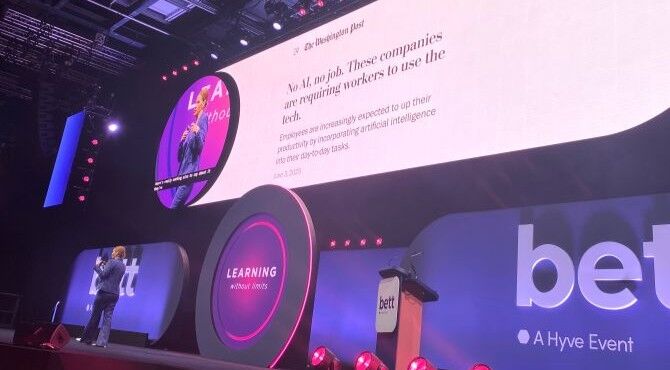
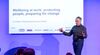
Annie Chechitelli, Chief Product Officer, Turnitin on how to responsibly incorporate generative AI.
30 January 2026
Across the three days, educators, policymakers and ed-tech experts debated how AI is changing classrooms, curricula and careers, and what this means for learners moving through increasingly global and digital labour markets.The event featured some lively keynotes. Mathematician and author Hannah Fry and journalist Amol Rajan, examined how AI is transforming education and society more broadly.The growing use of personalised learning tools and adaptive assessment, alongside ethical concerns around data use, creativity and authenticity were also discussed. While A.F Steadman reinforced the value of storytelling and imagination in the main arena, and Vivienne Stern MBE spoke on the future of higher education and the challenges it faces.Emphasis was placed on the need for education systems to evolve at every level — from classroom practice to leadership and policy — to ensure technology supports deeper understanding without eroding the human relationships central to effective teaching.
Don’t miss further coverage of BETT in the Education sections of our websites relocateglobal.com and thinkglobalpeople.com.

Subscribe to Relocate Extra, our monthly newsletter, to get all the latest international assignments and global mobility news.Relocate’s new Global Mobility Toolkit provides free information, practical advice and support for HR, global mobility managers and global teams operating overseas.
Building AI literacy through creativity
A core theme was that AI literacy must extend beyond technical knowledge. In a thoughtful talk on building AI literacy led by LEGO Education and LEO Academy Trust, speakers discussed the complexities and opportunities of teaching AI concepts to students.“We need to reflect carefully on the current system and ask ourselves if we are genuinely preparing young people for the world in which they are going to be living in,” said Cheryl Shirley, director of digital learning, LEO Academy Trust.“We have an opportunity here. We can just use AI to prop up the existing systems, marking the same tests and writing the same reports just faster. Or, we can recognise this huge opportunity for what it is and reimagine education – to make it truly inclusive and more impactful than it’s ever been before,” she continued.The session went on to share detailed examples of how her team are helping students to navigate the AI landscape responsibly and with curiosity, using creativity and child-first approaches that develop critical thinking alongside AI.Getting the workforce ready
Later panels at the show connected classroom change to wider workforce implications, focusing on the skills learners will need to succeed in AI-enabled economiesWorkforce readiness was a major theme with an insightful discussion including international panellists from Intel, Lenovo, Plymouth University and Old Dominion University.Audiences also heard from government ministers and institutions covering Canada, Mexico, Tajikistan and the US on their workforce priorities and how their governments are driving forward on AI literacy, skills and curricula to prepare learners for jobs that do not yet exist.The panel showed the need for more alignment between national policy, local practice and workforce demand, particularly as automation and digitalisation reshape economies worldwide. For globally mobile learners and professionals, it underscored the growing importance of lifelong learning and specific skills that translate across borders.Read related articles
- AI literacy and competency: The key to workforce readiness
- The Future of Work: Cultivating Innovation and Powering Discovery
- GSAIR 2025 report: Increased corporate relocation, Gen Z, AI, legislation and converging investment trends influencing growth of serviced apartment sector
- Charting the road to 2030: what does the future hold for global mobility?
- Global Mobility in transition: navigating compliance, technology, and the future of work
Leadership and digital transformation
This year featured a look at leadership in times of rapid technological change through the eyes of Sir Mark Grundy, CEO of Shireland Collegiate Academy Trust, and his three decades of innovation. The session focused on sustainable digital transformation, continuous learning and people-centred leadership.Rather than promoting rapid or heroic change, he noted the value of incremental progress and “mundanely clever” uses of technology that raise standards and support staff and learners over time. A perspective that resonated strongly with school leaders navigating complex international and digital environments.Integrity and responsible use of technologies
Responsible use of AI and other technologies both in and out of school and other learning environments was a persistent topic.An interesting talk by Annie Chechitelli, chief product officer at Turnitin asked: How much is too much AI? The focus was on how AI can support learning, writing development and critical thinking without undermining academic integrity.Drawing on global research and practice, her session explored how educators and institutions can guide students in the transparent and ethical use of generative AI, ensuring fairness and authenticity remain central to assessment in both secondary and higher education.Other highlights featured talks on the social impact of technology in schools, including a jam-packed session on the hotly debated idea of phone-free schools.The panel featured Sir Nick Gibb, former UK minister of state for education, founder and CEO of Yondr Graham Dugoni and director of education Emma Mills of One Community Trust who listed some convincing statistics on the benefits of schools going phone-free, from academic performance to social behaviour.Did you know?75% - The number of students who feel they cannot complete their work without AI.Source: KPMG report 2025 |

Find out more about the Think Global People and Think Women community and events.
Subscribe to Relocate Extra, our monthly newsletter, to get all the latest international assignments and global mobility news.Relocate’s new Global Mobility Toolkit provides free information, practical advice and support for HR, global mobility managers and global teams operating overseas.
©2026 Re:locate magazine, published by Profile Locations, Spray Hill, Hastings Road, Lamberhurst, Kent TN3 8JB. All rights reserved. This publication (or any part thereof) may not be reproduced in any form without the prior written permission of Profile Locations. Profile Locations accepts no liability for the accuracy of the contents or any opinions expressed herein.