From Classroom to Conference Room: BISU Students Visit the UN in Kyiv
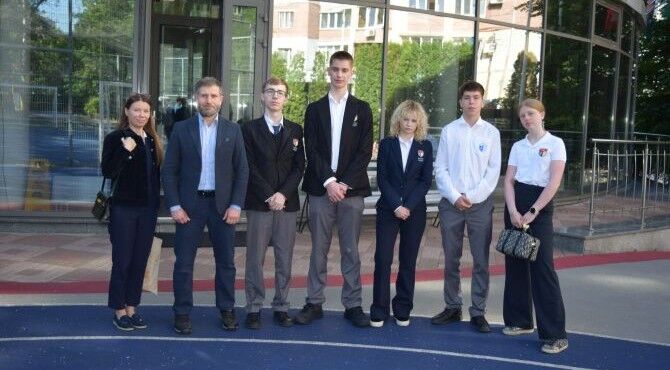
On the morning of 5 June 2026, a group of The British International School, Ukraine (BISU) Year 11 students studying Business and Economics left their classrooms behind and stepped into the world of international diplomacy. Their destination: the UN Resident Coordinator's Office in central Kyiv, where they spent ninety minutes in conversation with UN staff about one of the most pressing questions of our time: how do you rebuild an economy during a war?
A Session Built Around Real Questions
The session titled "How UN and Partners Advance Economic Recovery and Sustainable Development Goals in Ukraine During the War" was anything but a lecture. Held in the conference room of the RCO, the informal, classroom-style format was deliberately chosen to encourage open exchange. Students arrived with questions and were invited to keep asking them throughout.UN staff walked the group through the scope of the organisation's work in Ukraine – from emergency humanitarian support to long-term recovery frameworks. Short videos and field stories helped translate abstract agendas into human realities: what recovery financing actually looks like on the ground, what it means to leave no one behind when communities have been displaced, and why sustainable development cannot wait for peace.Interactive quizzes and activities kept the energy in the room high. Students were not passive observers – they debated, challenged assumptions, and offered their own perspectives on Ukraine's future.Paul Heslop, UN Senior Mine Action Advisor: "Recovery is not only about rebuilding what has been damaged. It is about shaping the future. Across Ukraine, new technologies, new ideas and new approaches are helping communities recover and adapt. It is inspiring to see young people engaging in these discussions today, because their perspectives and leadership will help define Ukraine’s future tomorrow."Connecting Global Ideas to Local Lives
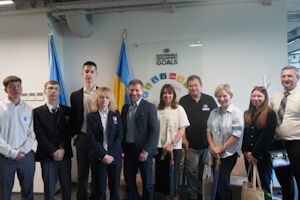
For many students, the session offered something their textbooks could not: a direct line between the concepts they study – GDP, recovery indicators, multilateral partnerships – and the institutions and people actually working to put those concepts into practice.BISU's Business and Economics programme places strong emphasis on real-world application of knowledge. The UN visit was a natural extension of that philosophy – a chance for students to see how international organisations function alongside governments and civil society, and to understand what careers in public service or international development might actually look like.Namik Khalilov, Business Studies and Economics Teacher at BISU, and one of the organisers of the BISU school visit to the UN office in Kyiv: “From my very first day at BISU, I fell in love with my Business Studies and Economics classes. The students are wonderful! Despite the significant challenges we currently face here in Kyiv, their resilience — coming to school every day and continuing their studies in bomb shelters during air raids — reminds me of my own youth and fuels my energy to support their growth. Seeing my students happy, successfully passing the UN Quiz and engaging so passionately in the Q&A session with the UN representatives leaves no doubt in my mind: joining BISU was absolutely the right choice.”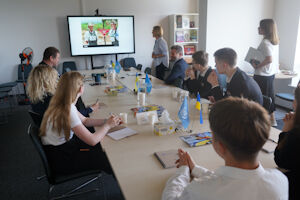
Read articles from The British International School Ukraine (BISU)
- We Made a Promise: Education as an Act of Hope in Ukraine
- Education Endures: Cambridge and BISU Building Ukraine's Future Together
- Standing with Ukraine: BISU Charity Wins International Award
The Students' Perspective
Growing up during a war changes the way young people think about the future. For BISU students, questions about reconstruction and recovery are not abstract – they are woven into daily life. The opportunity to put those questions directly to UN staff was not lost on them.Myron, BISU Year 11 Student: “As a young Ukrainian, I often think about the future of my country. This visit showed me that recovery is not only the responsibility of governments and organizations, but also of the younger generation that will help shape Ukraine’s future.”Iegor, BISU Year 11 Student: “Visiting the UN helped me understand that peace, recovery, and cooperation are not just political ideas, but real responsibilities shared by people around the world. This field trip made me think more deeply about my country’s future and the role our generation can play in rebuilding and improving it.”A Familiar Stage: BISU at COBIS Model Nations
The UN experience was not entirely new ground for BISU students. As a proud member of COBIS – the Council of British International Schools – BISU has twice sent student delegations to represent Ukraine at Model Nations debates. These international experiences have taken students to Prague and London, where they engaged in debate, diplomacy, and global dialogue alongside peers from around the world. That London delegation travelled during one of the hardest winters since the full-scale invasion began – freezing temperatures at home, damaged infrastructure, rolling blackouts. Students from both the Kyiv and Dnipro campuses made the journey, debated on behalf of their country, and returned safely to Ukraine. They came back, by all accounts, filled with reflection, inspiration, and a renewed sense of determination.It is that same spirit, the willingness to engage with the world even when the world at home is difficult, that brought this cohort of students to the UN conference room on 5 June.Mariia, BISU Y11 Student: "Before this visit, I mostly associated the United Nations with conflict resolution and peacekeeping. I was surprised to learn how much they also do in areas such as education, human rights, humanitarian aid, and sustainable development. It gave me a completely new perspective on the UN and its impact around the world."A UN–BISU Pilot With Promise
The session was designed explicitly as a pilot – a proof of concept for a model of UN–school engagement that both organisations hope to develop further. If this first meeting is any measure, the appetite on both sides is clear.For BISU, the collaboration reflects a long-standing commitment to educating students not only for academic achievement but for engaged, informed citizenship. For the UN Resident Coordinator's Office, engaging young Ukrainians directly is part of a broader commitment to inclusive, youth-centred recovery.As the students filed out of the conference room and back into the street, we had this feeling that our conversation was already continuing. That, perhaps, is the clearest sign that the session achieved what it set out to do.That, perhaps, is the clearest sign that the UN–BISU story has only just begun.Visit The British International School, Ukraine's Featured School page


Find out more about the Think Global People and Think Women community and events.
Subscribe to Relocate Extra, our monthly newsletter, to get all the latest international assignments and global mobility news.Relocate’s new Global Mobility Toolkit provides free information, practical advice and support for HR, global mobility managers and global teams operating overseas.
©2026 Re:locate magazine, published by Profile Locations, Spray Hill, Hastings Road, Lamberhurst, Kent TN3 8JB. All rights reserved. This publication (or any part thereof) may not be reproduced in any form without the prior written permission of Profile Locations. Profile Locations accepts no liability for the accuracy of the contents or any opinions expressed herein.