Wellbeing in the manufacturing industry
Manufacturing is under sustained pressure from rising costs and skills shortages to work‑related ill health. The importance of wellbeing in the workplace and needing to treat it with the same rigour as safety was highlighted at a Make UK conference.
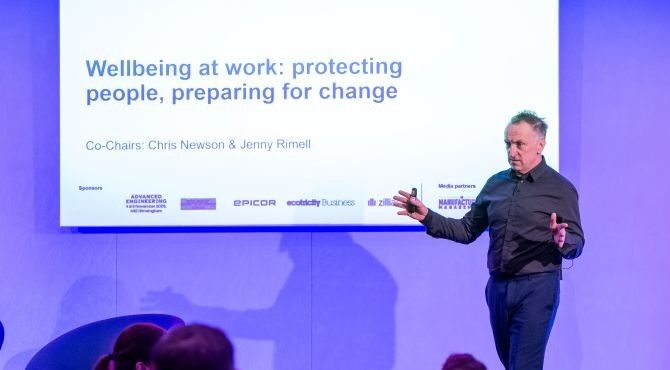
Wellbeing at work and protecting people for change was a key theme at the National Manufacturing Conference. Image courtesy of Make UK
The perception gap
The report uncovers a striking perception gap, with leaders believing they are proactive on health and wellbeing but many employees experiencing something far more reactive. And, while policies do exist, the research suggests they are not always understood.64% of senior leaders said their board was leading the way on health issues, while only 48% of those on the ground said that was the case. Highlighting the need for clearer communication, making wellbeing policies and support more visible and accessible and the need to measure how people feel about them.“91% of companies also had in place a suitable and sufficient manual handling risk assessment, so it’s quite common. When we asked them the same thing about wellbeing, it went down to 60%. When we asked them the same question about stress, it went down to below 50%. So less than 50% of companies surveyed had a stress risk assessment,” explained Newson.“Having a stress risk assessment is a legal requirement but about 50% of companies were non-compliant with the law. Stress is a common risk to a business regardless of what sector you’re in.”The survey also found that 88% of companies have manual handling training. However, when it came to those trained to manage stress, the number was 54%. When shop floor employees were asked the same question, the answer was 33%.Why wellbeing matters
While risk assessments are being carried out, the survey showed that actions are not consistently visible. The results also show that training is strong for physical health, yet far weaker for stress and psychological wellbeing.The consequences are real too. Employees linked declining wellbeing to lower morale, reduced productivity, and increased absence but they also identified some clear, practical steps that would make a meaningful difference.When employees were asked what would improve their sense of wellbeing at work, more training and development was the answer for a significant 50% of people, showing the appetite for change is real and shared across the workforce.Newson also added that 38% of companies didn't have an employee assistance programme (EAP). Although not a legal requirement, he noted it was something that a lot of companies had in place and that employees have found helpful.Newson talked about health and wellbeing as a business necessity and discussed the economic impact of neglecting it. Stating attracting and keeping talent is no longer simply a recruitment issue but a risk to growth, competitiveness, and resilience.“Workforce capacity is a significant issue in the UK. We have 50,000 long-term vacancies that we're finding difficult to fill as a country. Retention is a problem and a strategic risk in an organisation. It may be one of your biggest risks. If we don't look after people, both from a psychological and a physical health point of view, there's not a lot to encourage them to work with us and stay with us. You can see how this all links together.”Focusing on the need to put data in the action, Newson discussed the government’s Mayfield Review otherwise known as Keep Britain Working. The report aims to address the economic inactivity crisis – where over 1 in 5 working-age adults are out of work, mostly due to ill-health, higher than Sweden, Denmark and the Netherlands.The paper also looks at reforms for workplace health provision and the development and adoption of a healthy working lifecycle, from onboarding to retention and supporting a return to work.He shared what the HSE are doing around health and wellbeing at work, including their prevention initiative and a wide range of resources now available for employers and added that the HSE will soon be taking enforcement action.“The HSE have promised that 100% of proactive workplace inspections will focus on health and wellbeing. It doesn't mean they're not going to look at safety. They are going to look at your machinery and your work operations. They're going to look at your yard and logistics but they will definitely be looking at health as well. That's what they’ve committed to do. This is a problem in the UK we've got to do something about – both in a proactive and a reactive way.”Read related articles

Making support tangible and meaningful
Rimell later noted that similar to safety, stress and wellbeing also require risk assessment and proper support and that work safeguarding should be as thorough as child safeguarding in schools.“Our report shows us that 56% of managers are just not confident in dealing with this kind of stuff so it’s no surprise then that 58% of employees surveyed don’t feel safe to talk about their wellbeing at work.”Rimell empathetically stated that for managers it's often clear and straightforward what you need to do when it comes to physical risk but not so much when it comes to wellbeing. Furthermore, this lack of knowledge on wellbeing support unintentionally creates a “culture of fear” around the topic.“Do you remember when people used to say, just leave that at the door? When you come to work, just leave that at the door. When I hear that saying, I often think of somebody coming to work with a rucksack on their back with all the stuff they’re dealing with. How many of you then tell teams to bring their whole selves to work? Because what we’re doing there is encouraging people to keep their rucksack on and bring it in. To bring the whole of themselves to work. But if we want to know what's going on in those rucksacks, or at least the fundamental bits that can help us support them, then we have to create an environment where it's safe for them to talk.”Rimell reeled off sobering statistics to illustrate the numerous things that people are dealing with and bringing into work, some of which have increased post-pandemic, from domestic violence to financial hardship, marriage issues and caring responsibilities.“That is all part of work – they are not just forces that occur outside the workplace,” she added. “And every one of those things can be a constant thought and worry for an employee that leads to stress, depression or anxiety. An HSE report shows us that 52% of our workforce is off due to work-related stress, depression or anxiety.”Although organisations can’t control these things that occur outside the workplace, Rimell said there are many things organisations can control, and ways they can drive change.“We can control how long we give someone when we ask them how they are. There are people in this room that can control how much budget is given to wellbeing. There are also people that can absolutely implement wellbeing strategies and how that should best play out in their organisation. This is all within our gifts,” said Rimell.“And, if you're one of the 38% of organisations that have EAPs in place – promote these”, said Rimell. EAPs have a reputation of being really expensive but they actually cost between £5 and £15 per person per year. The EAP Association shows you get an ROI of £10.85 for every £1 you spend. And the reason that return is so high is because you're giving your team tools to go have a good conversation with qualified people, whether that’s financial advice or counselling. It’s a good way to keep people at work too because they can access this and have somebody to talk to confidentially, rather than feeling they've got to be off work.”Did you know?56% managers are not confident in dealing with wellbeing issues52% of reported work-related ill health was categorised as stress, depression and anxiety |
Number crunch£16.4 billion annual cost to the economy for work-related ill health25% amount of the annual cost of workplace ill-health that falls on employers |


Find out more about the Think Global People and Think Women community and events.
Subscribe to Relocate Extra, our monthly newsletter, to get all the latest international assignments and global mobility news.Relocate’s new Global Mobility Toolkit provides free information, practical advice and support for HR, global mobility managers and global teams operating overseas.
©2026 Re:locate magazine, published by Profile Locations, Spray Hill, Hastings Road, Lamberhurst, Kent TN3 8JB. All rights reserved. This publication (or any part thereof) may not be reproduced in any form without the prior written permission of Profile Locations. Profile Locations accepts no liability for the accuracy of the contents or any opinions expressed herein.