Lessons in resilience & rising from adversity: Resilience, leadership & the power to change your story
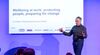
In her speech, Dr Sabrina Cohen-Hatton KSFM, Chief Fire Officer, Neuroscientist, Author and International Speaker, spoke about the importance of psychological safety in the workplace, and how to make organisations more inclusive and welcoming. Marianne Curphey reports from the CIPD annual conference.

9 December 2025

View your copy of the Winter 2025/26 issue of Think Global People magazine
Click on the cover to access the digital edition.
Having left home at 15 and left school at 16 and having slept rough on the streets of Newport in South Wales, she admitted that she had often felt like an outsider. Although she was grateful for the opportunities she received as a trainee firefighter, she also encountered resistance from some colleagues who resented her being there.“When you are so very different to everybody else around you, it can take a while to feel comfortable in your own skin, and that was definitely my experience,” she said. “But when you realise that you can't conform to the stereotype, it's really empowering, because you realise you're no longer constrained by them either and that can be incredibly freeing. Sometimes that freedom, that real value in being different, can be a superpower. It can help you to see and take the opportunities that might feel like a really difficult challenge.”Her interest in workplace safety, both physical and psychological, was born out of a serious incident involving her husband while they were both on duty as firefighters and this drove her to investigate why accidents happen.
Read related articles
- Psychological safety: Actions and benefits in the workplace
- From powerful conversations to practical change, Findings of Think Global Women 2025
- Future-proofing your organisation: the importance of measuring and defining culture
- Leading with purpose: A life of leadership and innovation
“I found that the majority of injuries happen as a result of human error, not a problem with a piece of equipment or a policy, but a human mistake,” she said. “Someone somewhere would make the wrong choice in the wrong place at the wrong time, but that meant people would get hurt. I thought, maybe we can understand it a little better, then there's something that we can do to reduce it.”She didn’t have any qualifications, so she went back to night school and studied psychology all the way through to a PhD, learning about how people make decisions under pressure.“After my PhD, I started to co-supervise a small research group at Cardiff University,” she explained. “We've had a programme of research now since 2013 looking at how firefighters make decisions and training them to make better decisions. As a result of our research, we completely changed the way that we deal with incidents. Now in the UK, we changed our national policy and we've got new training methods.”She also does a lot of work now on creating an environment where people have a sense of psychological safety.“It is not just about people coming to work and feeling happy all the time,” she explained. “Psychological safety is hard. It means that you're prepared to have a difficult conversation. It means knowing as a worker that you're not going to be personally blamed or reprimanded and you can figure out what went wrong in the system so that you can fail fast and succeed even faster next time around. Psychological safety for me has been the key in leadership.”


Find out more about the Think Global People and Think Women community and events.

Subscribe to Relocate Extra, our monthly newsletter, to get all the latest international assignments and global mobility news.Relocate’s new Global Mobility Toolkit provides free information, practical advice and support for HR, global mobility managers and global teams operating overseas.
©2026 Re:locate magazine, published by Profile Locations, Spray Hill, Hastings Road, Lamberhurst, Kent TN3 8JB. All rights reserved. This publication (or any part thereof) may not be reproduced in any form without the prior written permission of Profile Locations. Profile Locations accepts no liability for the accuracy of the contents or any opinions expressed herein.