Manufacturing skills crisis
Skills were a hot topic at the National Manufacturing Conference as labour demands continue and vacancies remain unfilled amid rising youth unemployment.
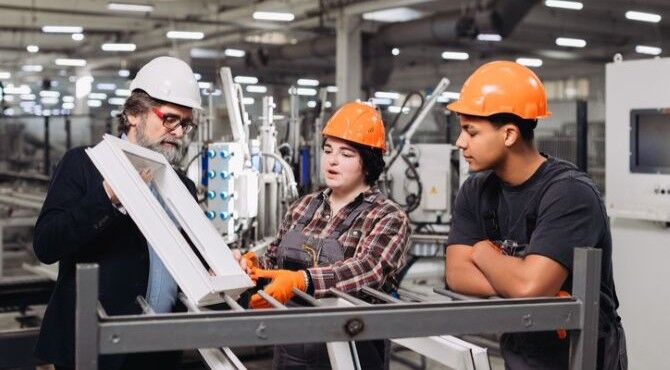
Credit:Dmytro Sheremeta
17 March 2026
Global competition, an ageing workforce with many retiring in the next five to 10 years, rapid technological change and funding were all cited as part of the skills challenge by industry.Stephen Phipson, CEO of Make UK, called for a “skills revolution” to grow the UK’s capabilities as well as its security and resilience and discussed the need to encourage more young people into the manufacturing sector.“We should be ashamed that we have one million 18-24 year olds not in education, employment or training (NEET) in the UK,” he said prompting the government to move further and faster on skills reform.Political representatives were questioned on skills, industrial strategy and funding as manufacturers shared pinch points and the need for further support and flexibility to invest in training and apprenticeship programmes. Some spoke on the decline of engineering and manufacturing apprenticeships amidst a NEET crisis.Throughout the event, attendees explored the implications of advancing automation, AI and skills gaps as well as changes to the global supply chain and ways of working.As workforce demands evolve, many companies shared how they are planning to invest in upskilling and retraining existing employees to stay competitive in the labour market.A later panel session on the skills landscape explored findings from Make UK’s Industrial Strategy Skills Commission, including recommendations for training providers and employers as well as insights from various companies on how they are meeting their own labour demands.

Subscribe to Relocate Extra, our monthly newsletter, to get all the latest international assignments and global mobility news.Relocate’s new Global Mobility Toolkit provides free information, practical advice and support for HR, global mobility managers and global teams operating overseas.
The panel
- Rt Hon Robert Halfon, Executive Director, Make UK, and former Minister for Skills, Apprenticeships and Higher Education (moderator)
- Rachel Wilson, Director of People and Organisation, Siemens plc in Great Britain & Ireland
- Paul Birtles, Operations Director, Produmax (SME)
- Jamie Cater, Senior Policy Manager, Make UK
On the manufacturing skills gap
Jamie Cater: When we did the Industrial Strategy Skills Commission last year we did some research with member companies on upskilling, training, what the demand was in different areas and what types of training they used. We know that over the next five years over half of employers in the sector are going to significantly increase their investment in training existing workers specifically, excluding new recruits and people coming into the sector for the first time. A key priority of that is leadership and management. Whenever we survey member companies on where they want to invest in skills training – leadership and management comes across as a really critical skills gap across the sector. That is then followed by higher technical skills, digital skills and green skills.Rachel Wilson: The World Economic Form estimates that by 2030, 39% of skills will be disrupted. 6 in 10 workers will need reskilling – that’s not a one-off event. That's a permanent condition that we need to address. Successful organisations will be those not with the best forecast but ones that build learning systems that can flex, adapt and scale.On recruitment, talent and growth
Rachel Wilson: We put foundational skills at the centre of everything we do. We also talk about recruiting learners, not knowers. We want people that are able to learn and quickly adapt to new technologies. It’s about recruiting people for a growth mindset. We’ve overhauled our recruitment process and started to assess for some of those foundational skills at the core, rather than just demanding 10 years experience in say welding, or some deep domain expertise. For us, as AI gets more capable, we know it’s those human skills that will be really required to cooperate and work with AI for the future.Paul Birtles: Our ability to grow as a company has been down to our work with apprentices. People say it’s hard work, it is, but the benefits you get out of it as a company are phenomenal. There are too many businesses that don’t see the potential or understand the opportunity of taking on apprentices.I go to many of these events and talent gaps come up constantly in conversation and when you ask how many apprentices they have – there’s no answer. I’m sorry but you’ve got to build it yourself. It’s what we have had to look at and do and it’s been a key driver for us. We’re very proud of our story. It's transformed our business.Related reading
- Manufacturing change
- Developing skills for green jobs
- AI literacy and competency: The key to workforce readiness
On training, learning and apprenticeships
Rachel Wilson: We’ve made life-long learning really visible as an organisation and have been embedding it into our culture over the last five years. We’ve set ourselves an ambitious target of 50 hours of learning per employee. We work really hard with leaders to ensure their teams are achieving those 50 hours per employee and if not, we want to know why not. But the number alone is not the point. It’s about leaders role modelling those learning behaviors too. We did some research and found a positive correlation that shows when leaders learn, so do their teams.Jamie Cater: 70% of manufacturers are using apprenticeship training to upskill and retrain their staff. One of the bits of anecdotal feedback we get from employers is that apprenticeships are used for upskilling but not necessarily because they are the best suited or most appropriate format of training. More so that if you are an apprenticeship levy payer, it's the money that you have and so that's an effective way of using it. Apprenticeships are a recognised model in the workplace but I think the government is now recognising that we perhaps need some flexibility in that apprenticeship training to make sure that it is efficient and cost-effective for employers to use. So they don’t have to put someone on a full apprenticeship if they don’t need that full 12,18 or 24 months but can access the right bit of that training, in the right format, so it gives them what they need. Paul Birtles: Each year, we’re taking on 6-10 new apprentices. It may not sound a lot but when we first started we had a workforce of about 30 people. We’ve slowly built that workforce over time and now we’re at 104 people, 27% of our current workforce are apprentices. Due to the way we’ve done it, about 60% of our workforce is now under the age of 30 which in advanced engineering is unusual. We’ve gone from an average age of 47 when I enjoyed the business to 34. The industry average is around 52. What that’s brought for us is a young person’s view into an old person’s industry.On workforce transformation and future-proofing
Rachel Wilson: When it comes to workforce transformation, reports from the likes of McKinsey show that 70% of transformations fail because of a weak people strategy or employee resistance to change. That’s why workforce transformation can’t be a side project. It has to be core to competitiveness, innovation and delivery.We have to treat skills as a system not as an HR framework with our old skills matrices and we have to treat it like a transformational programme. For that, we have really clear ownership around the skills and clear targets that matter with incentives for our leaders to deliver on those skills changes. We also have very tailored learning strategies. Our diverse workforce includes everything from AI specialists, to service engineers on high-speed trains and welders in manufacturing so we can’t have one learning strategy for all of those different types of people. What we do know is that the learning strategies that are short, and always well integrated into work on a day-to-day basis, are the ones that really work.The shape of UK manufacturing in numbers70% of manufacturers now have employees working beyond state pension age, with one in four continuing for five years or more after retirement53% manufacturers believe the education system can deliver the skills they need by 203065% manufacturers expect to employ more people by 203665% expect AI to increase productivity32% manufacturers expect a reduction in the need for low-skilled labour as a result of AI50,000 the estimated amount of live vacancies in the manufacturing sector1/3 manufacturers say their biggest barrier to growth is skills and workforce gapsSource: Make UK |
Did you know?According to Make UK over £1 billion has been raised from employers for skills via the Growth and Skills Levy and Immigration Skills Charge which is not being used to support employer investment in training despite industry labour shortages. |
Futureproofing the workforce: success storiesIn the afternoon, delegates heard from various manufacturing firms including Amanda McLaren, MD at AW Hainsworth, Ben Wilson, MD at MPM and Martin McKervey, Non-Executive Director at AESSEAL who have all upskilled and retrained their workforce to meet evolving industry demands. From electrical and mechanical to robotics and textiles, the panellists shared how training and apprenticeships provide a strong return on investment. |

Find out more about the Think Global People and Think Women community and events.
Subscribe to Relocate Extra, our monthly newsletter, to get all the latest international assignments and global mobility news.Relocate’s new Global Mobility Toolkit provides free information, practical advice and support for HR, global mobility managers and global teams operating overseas.
©2026 Re:locate magazine, published by Profile Locations, Spray Hill, Hastings Road, Lamberhurst, Kent TN3 8JB. All rights reserved. This publication (or any part thereof) may not be reproduced in any form without the prior written permission of Profile Locations. Profile Locations accepts no liability for the accuracy of the contents or any opinions expressed herein.