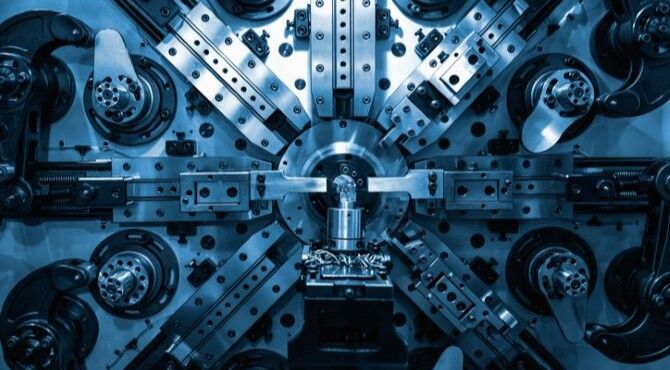
Manufacturing change
High energy costs, global tariffs, innovation, skills, decarbonisation and strategies for growth were all key topics at the National Manufacturing Conference 2026.
5 March 2026

This article is taken from the Spring/Summer 2026 issue
of Think Global People magazine
Click on the cover to access the digital edition.
Members of the manufacturing sector stretching across multiple industries, regions and countries, gathered for the annual manufacturing convention at QEII in Westminster this week.Equipping the sector for uncertainty was a steady theme on the day. Long-term host, journalist and engineering champion, Steph McGovern, opened the event and ushered in a long line of speakers, from industrialists to manufacturing innovators, journalists and politicians to help businesses navigate what is a turbulent time for most sectors.Jon Sopel, broadcaster and author gave an overview of the US and Israeli war with Iran and the current geopolitical crisis. Sopel gave some broader political and economic predictions and took a wider look at global tariffs which continue to impact stability, operations and strategic advancement for many companies, as well as US foreign policy and its relationship with the UK.On a national level, skills shortages, unemployment and investment in training were persistent topics as well as future planning and innovation and the UK’s industrial strategy and advanced manufacturing plans in the face of rapidly advancing technology and external threats.
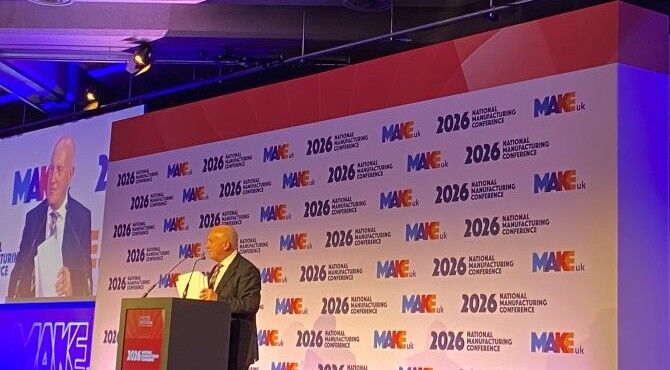 Stephen Phipson, CEO of Make UK
Related reading
- Financial markets rattled by fresh trade uncertainty
- Developing skills for green jobs
- UK manufacturers recalibrate trade strategies as tariffs bite
- Steph McGovern launches new Teesside University scholarship to support women in engineering
- UK manufacturing climbs one place to 11th in global rankings
Kyle explained how his department is working to manage disruption to trade and supply chains. He talked of resilience, competition and “championing the next generation of manufacturing” and cited strategies that had been launched and claimed investments in areas such as electrification of vehicles, plants, batteries, electric motors and hydrogen fuel cells.“Our competition is racing to secure industrial supremacy. They are investing in smart factories. In advanced propulsion. In robotics. And we have got to keep up. In this world, securing Britain’s transition to next generation manufacturing is not an option. It’s a strategic imperative. But to do it we need to look at how things are designed, made and sold around the world. In other words: conception, production and utilisation,” he said.Looking at conception and how things are designed, Kyle noted that in the ‘next generation economy’ value is increasingly captured at the design stage.“Artificial intelligence, digital twins, advanced simulation, and data-driven engineering are transforming how products are imagined. Long before they are ever built. The factory of the future begins not on the shop floor, but on a high-performance computer.”But conception alone is not enough. “We must modernise production. We must maximise utilisation,” he chanted.“Right across the world, advanced economies are reindustrialising. The European Union is investing heavily in semiconductor resilience. In the US, Congress has passed landmark legislation. It is onshoring critical supply chains for manufacturing. And in East Asia, economies continue to lead in robotics density and advanced electronics production. For us to compete, our factories can’t be relics of the past. They have to be models of the future.”Throughout the morning and afternoon, breakout sessions covered everything from the Employment Rights Act to health, safety and wellbeing at work and how to protect and prepare people for change. Other work streams took a deeper look at the skills landscape, from the value of apprenticeships to training support and investment as well as future-proofing, greener manufacturing trends and innovation.The later sessions explored strategies for growth – including an in-depth panel talk on the future of Britain’s steel industry and its global role amid a tariff war and another on the circular energy economy and opportunities for the sector.Rounding up the conference attendees were treated to an inspirational keynote by former combat helicopter pilot Sarah Furness who aptly talked about courageous leadership under fire.


Find out more about the Think Global People and Think Women community and events.
Subscribe to Relocate Extra, our monthly newsletter, to get all the latest international assignments and global mobility news.Relocate’s new Global Mobility Toolkit provides free information, practical advice and support for HR, global mobility managers and global teams operating overseas.
©2026 Re:locate magazine, published by Profile Locations, Spray Hill, Hastings Road, Lamberhurst, Kent TN3 8JB. All rights reserved. This publication (or any part thereof) may not be reproduced in any form without the prior written permission of Profile Locations. Profile Locations accepts no liability for the accuracy of the contents or any opinions expressed herein.