Sustainability in International British Education
Preparing Future Leaders for a Changing World
9 December 2025
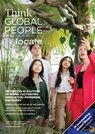
View your copy of the Winter 2025/26 issue of Think Global People magazine
Click on the cover to access the digital edition.
Gemma Thornley, Principal, Arbor School

Why Sustainability Matters to Tomorrow’s Talent
The next generation will inherit a world shaped by environmental pressures, technological disruption and economic uncertainty. As global industries evolve, employers are increasingly looking for graduates who can:- think critically about complex systems
- collaborate across cultures and disciplines
- innovate responsibly
- communicate with clarity
- adapt to rapid change
Sustainability in British Curriculum Context
In many international schools, sustainability appears in pockets: a recycling drive here, an eco-club there. But a genuinely forward-thinking approach is using it as a lens through which students learn - not a standalone initiative.This is where the British curriculum offers strength. Its emphasis on enquiry, academic challenge and interdisciplinary opportunities creates space for sustainability to be woven through science, humanities, maths, the arts and even physical education.Sustainability becomes a way of thinking: students explore climate systems in geography while analysing energy data in mathematics; examine the ethics of consumption in English literature or through drama-based role play; and use fieldwork, lab investigations and outdoor learning to understand environmental systems first-hand.This integration of knowledge mirrors the complexity of the real world – preparing students to connect ideas, challenge assumptions and propose solutions.
Case Study: Ecological and Environmental Education at Arbor School Dubai
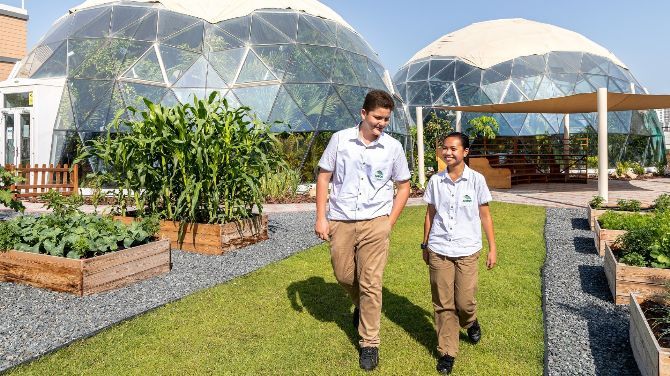
At Arbor School, where I serve as Principal, sustainability is embedded into every stage of the British curriculum. Our approach blends academic rigour with real-world environmental inquiry through both an ecocentric and technocentric lens. It extends from the way teachers plan lessons, to the design of our living campus, to the opportunities students are given to take action.In Primary, ecological inquiry begins with sensory exploration and curiosity. Young children learn through play, outdoor discovery and hands-on experiences in our biodomes and gardens. They begin to understand the natural world not as an abstract concept, but as something they can see, touch and care for.At Key Stage 3, the curriculum becomes increasingly conceptual. Students follow a British model of discrete subjects – English, maths, science, humanities, the arts – but teachers look for ways to connect content through an ecological lens. A unit on urban architecture in Year 7 as an example might link physics, mathematics, geography and drama, encouraging students to see the interconnectedness of systems.At Key Stages 4 and 5, sustainability shifts from exploration to advocacy. Every student completes the additional Global Perspectives GCSE, which deepens analytical thinking on global issues. They also undertake Arbor’s own Global Impact Certificate and may extend this into an Extended Project Qualification (EPQ) focused on sustainability, innovation, or social impact. These pathways give students tangible credentials that strengthen university applications and build confidence in addressing large-scale challenges.This model recently earned Arbor the World’s Best School Prize for Environmental Action 2025, recognising not just our facilities or curriculum, but the way students engage with sustainability as thinkers, researchers, collaborators and advocates.Beyond Academics to Future-Readiness
Relocation specialists and global mobility leaders increasingly report that parents want schools that will prepare children for life, not just exams. Sustainability-focused British schools are uniquely placed to do this because the competencies needed for environmental understanding mirror those in global leadership.At Arbor, for example, creativity, sport and leadership are seen as extensions of ecological and environmental education. Students learn to communicate ideas through the arts; develop resilience, teamwork and wellbeing through DASSA and BSME sports; and practise ethical decision-making through roles on the student council, eco-committee and ambassador programmes.These experiences help students build the courage to speak up, collaborate and take responsibility; all essential attributes in the workplace.Higher Education and Career Success
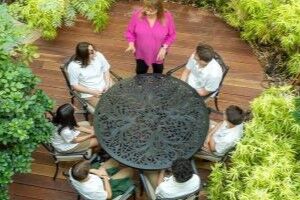
For internationally mobile families, university pathways are often a top concern. Sustainability education does not replace strong academics – it enhances them. Students who learn through inquiry, systems thinking and real-world application often produce exceptional academic outcomes because they understand the purpose behind their learning.At Arbor, the Secondary Futures Counselling Programme further strengthens this journey. From Year 9 onwards, students receive guidance on subject choices, career profiling, university applications and wellbeing. Every Year 12 student completes a work placement in a sector aligned with their interests, from engineering and life sciences to hospitality, creative industries and environmental consultancy.In a global talent market increasingly influenced by ESG, these experiences set students apart. They leave school with academic qualifications and evidence of qualities that top universities and employers recognise: leadership, agency and real-world experience.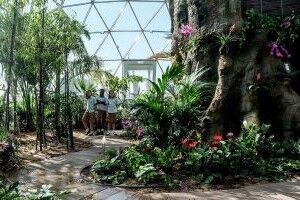
The International Mobility Agenda
For global mobility professionals, sustainability in schooling offers several advantages:- Stronger transitions for expat families
- Alignment with company ESG goals
- Future-proofing talent
- Enhanced family satisfaction
Visit The Arbor School, Dubai's Featured School page


 Read Relocate Global's Guide to International Education & Schools which is packed with expert tips and information for those relocating and the professionals supporting them.

Find out more about the Think Global People and Think Women community and events.
Subscribe to Relocate Extra, our monthly newsletter, to get all the latest international assignments and global mobility news.Relocate’s new Global Mobility Toolkit provides free information, practical advice and support for HR, global mobility managers and global teams operating overseas.
©2026 Re:locate magazine, published by Profile Locations, Spray Hill, Hastings Road, Lamberhurst, Kent TN3 8JB. All rights reserved. This publication (or any part thereof) may not be reproduced in any form without the prior written permission of Profile Locations. Profile Locations accepts no liability for the accuracy of the contents or any opinions expressed herein.