Taking a child-first approach to AI literacy
AI is redefining the world, while schools are busy shaping policy. A child-first approach that helps students develop their creativity and critical thinking could be the best place to start.
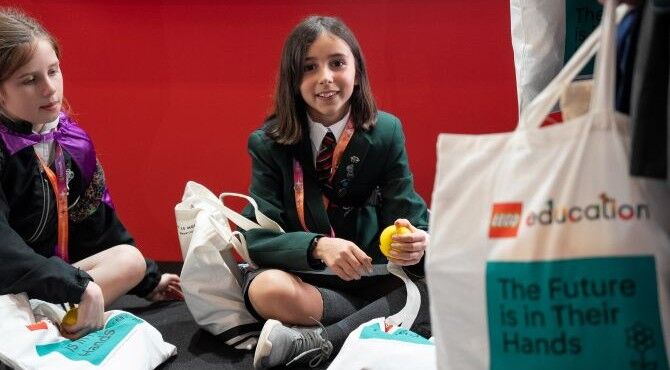
Image courtesy of BETT
23 February 2026
“AI literacy shouldn’t be about teaching children how to use a magic box. It should be about handing children a screwdriver to take the magic box apart and build things from the pieces,” said Andrew Sliwinski, head of LEGO education product experience, in his keynote at BETT.Addressing an arena of educators, technologists and policymakers he discussed the need for children to shape AI. Sliwinski discussed hands-on learning and taking a more child-first approach when teaching AI concepts to students to promote literacy, creativity and thinking.According to LEGO Education, a common concern among teachers is that while their students approach AI tools with confidence, they often lack comprehension. So, how can we ensure students understand the fundamental concepts underlying AI systems? Sliwinki was joined by educators from LEO Academy Trust to share their unique approaches to building AI literacy.
Don’t miss further coverage of BETT in the Education sections of our websites relocateglobal.com and thinkglobalpeople.com.

Subscribe to Relocate Extra, our monthly newsletter, to get all the latest international assignments and global mobility news.Relocate’s new Global Mobility Toolkit provides free information, practical advice and support for HR, global mobility managers and global teams operating overseas.
The panel
Moderator: Andrew Sliwinski, Vice President, Head of Product Experience, LEGO EducationCheryl Shirley, Director of Digital Learning, LEO Academy TrustJulaan Govier, Class Teacher, Curriculum Leader and Digital Champion, LEO Academy TrustOn shaping AI policy for schools
“Never let the tail wag the dog. And what I mean by that is never let the tech lead the learning, or let the tech lead what’s right for the child. We need to start with what we want children to learn and how we want them to learn it and then the tech follows that.” Andrew Sliwinski.“At the LEO Academy we really believe if we just teach students the ‘how’ with AI they’re just going to be passive passengers. We often describe the current landscape of technology as being like an AI avalanche. It’s our job to make sure children don’t just run away, or hide – we want them to ride the wave safely and skillfully with purpose.” Julaan Govier.“When generative AI became more popular, schools went into a sort of reaction mode and felt they needed an AI policy that would set expectations and we did the same. The more we lived with the policy and stripped it all back, we realised AI aligns in everything that we do. This is our kind of golden thread across every policy we have, so we’re not ringfencing it now, or giving it its own document. We’re thinking about how AI fits into our teaching and learning strategy and [across lots of other areas]. The lesson we learnt was simple – if we have a separate policy, we’re making it niche and the job of the IT team but by threading it through everything we do – it becomes everybody’s responsibility.” Cheryl Shirley.On building and teaching AI literacy
“To focus on foundational AI literacy, we moved from a black box mentality to a glass box mentality. We want them to not just think about how to write prompts, but to understand the mechanics under the hood. We do this in three ways.The first one is playful and practical – thinking about metacognition. We want to use hands-on tools and educate children to use physical technology to make abstract concepts tangible. We also want them to think about their own thinking and reflect and when they’re machine learnt, we want them to compare that to how they learn.Secondly, we focus on computational thinking and strip away the sort of mystery and magic. Our curriculum ensures that children understand the difference between computer vision, statistical data and natural language processing. When they understand the “how” then the magic turns into an actual tool they can control.Thirdly, and perhaps most importantly, is building that ethical compass – digging into the “should we” not just the “could we”. AI literacy means being able to spot bias and transparency and making sure they understand that data is never neutral.” Julaan Govier.Read related articles
- AI literacy and competency: The key to workforce readiness
- BETT 2026: Learning without limits
- Building students for an AI-driven workforce
- Exploring phone-free schools
On AI for creativity and mythbusting STEM
“We need to foster hands-on learning and creative collaborative experiences for children. We don’t want computer science and AI to be seen as a subject that’s for nerds. We need every student to engage with these topics,” Andrew Sliwinski.“For too long computer science has been seen as a nerd subject, where something happens in a dark room with a glowing light. We want to move and engage every learner and change that narrative from technical skill to the creative empowerment we can give our young people. We’re trying to turn AI from that technical hurdle to a creative tool, just like a paintbrush or a building block.” Julaan GovierOn education policy in the age of AI
"I would ask policymakers to really reflect carefully on the current system and think to themselves are they genuinely preparing young people for the world in which they are going to be living in. You have an opportunity here, right now. You can just use AI to prop up the existing systems – marking the same tests and writing the same reports, just faster. Or, you could recognise this huge opportunity for what it is. The single greatest opportunity in our lifetime to reimagine education. I think we’re at a point now where we can genuinely make learning inclusive for everybody and can support the people that some of the current systems have let down. We’ve got an opportunity to make education more impactful than it’s ever been before.” Cheryl Shirley.| 69% of global teachers say AI literacy is critical for students’ futures40% of global teachers report their schools aren’t prepared to teach AI literacy responsibly79% of global teachers say their students feel confident using AI63% of global teachers also say students don’t know how to use AI responsibly90% of global computer science teachers have received high-quality professional training to teach AI literacy49% of global computer science teachers feel uncomfortable teaching AI literacy to students even after trainingSource: Building the Future: A Global Report on Computer Science & AI Education, LEGO Education |
Empowered AIUniversity College London students at the BETT conference showcased how they designed their own ed-tech tools to support K12 and SEND learners. The projects highlighted the value of hands-on learning and what happens when students lead on AI tool design and integration.Interesting tools designed by students included AvatarForms – an AI-based app to assist neurodiverse students, and MirrorMirror PenPals AI – a video portal social network to help teachers connect classrooms globally and create a richer international student experience. |
Don’t miss further coverage of BETT in the Education sections of our websites relocateglobal.com and thinkglobalpeople.com.

Find out more about the Think Global People and Think Women community and events.
Subscribe to Relocate Extra, our monthly newsletter, to get all the latest international assignments and global mobility news.Relocate’s new Global Mobility Toolkit provides free information, practical advice and support for HR, global mobility managers and global teams operating overseas.
©2026 Re:locate magazine, published by Profile Locations, Spray Hill, Hastings Road, Lamberhurst, Kent TN3 8JB. All rights reserved. This publication (or any part thereof) may not be reproduced in any form without the prior written permission of Profile Locations. Profile Locations accepts no liability for the accuracy of the contents or any opinions expressed herein.