Unplugged – An Impactful Way to Put the Phones Down
There has always been distraction in the classroom. Anyone who has ever stood before a room of students knows the challenge in capturing young people’s attention. The low murmur of a conversation between peers that lingers or a note passed between neighbouring desks. The root of distraction is visible.
1 June 2026
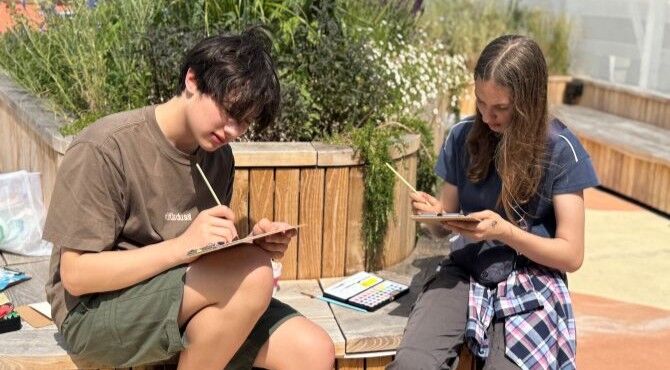
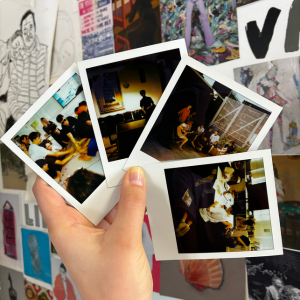
These distractions still rear their head in classrooms today, but they have been accompanied by an even more common interruption. One that draws our students’ attention out of the classroom to something or someone much further away. Today, a student can be physically present and still be somewhere else entirely. This time not with a table mate, but chasing a notification from a device that is so enticing that even our most compelling teachers can’t compete. We are living and working in the most connected era in human history; devices are no longer “nice to have,” they're woven into the fabric of our lives.Halcyon London International School has always positioned itself as a tech forward school, and is recognised as a Google Reference school. As such, we are working to strike the balance between preparing students for a digital world and preserving the very human connections that make education more than just information transfer. It is precisely this balance that drives our phone-free policy: in preparing our students for a digital future, we must not forget to protect their ability to connect with each other in the real world.Whether mobile phones belong in classrooms has sparked debate among legislators, parents, and teachers alike. While UK statutory guidance advises that “all schools should be mobile phone-free environments by default,” a sharp counter-argument sits at the opposite end of the spectrum. It’s the familiar refrain that technology and AI aren’t going away, and that banning their use risks leaving students ill-prepared for a digital future. Frankly, the points are valid. Both can be true, right?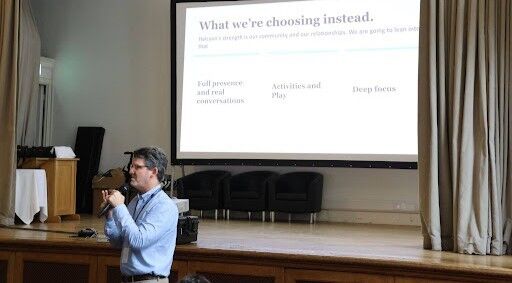 That is where Halcyon London International School finds itself sitting. Practicing a balancing act between tactfully incorporating technology, while guiding our students to embrace off-screen connection. As Halcyon Director Jeff Lippman expressed:“I think we will be repeating a mistake of following pendulum swings if we abandon tech completely. We need to use tech in very specific ways so that it does not distract or lower cognitive growth, but still provides for transformative learning that would be impossible without it. What does that look like? That is for us to determine.”Despite Halcyon being an independent school, and therefore exempt from the state mandate, we have made the deliberate choice to run a phone-free campus. Over our thirteen-year history, two things have been constant in regards to our school’s foundation: student wellbeing and ensuring students are fully prepared for the digital revolution. At first glance, given the mounting concerns surrounding smart devices, these two specific constants may sound in conflict with one another. But Halcyon’s holistic IB model has always welcomed differing perspectives, one that challenges its students to question and strike a healthy balance.By implementing our phone-free model, we hope to enable deeper focus, greater social time, and an even stronger emphasis on wellbeing. We want to be clear with our students: this initiative is not a judgment on them, nor is it an attempt to demonise technology. In fact, during our own reflections, our staff readily admitted to their own elevated screen times. The purpose of this policy isn’t to police our students, but to reintroduce vital peer interactions that have been eroded by smart devices and the online world they provide a gateway to.That is why Halcyon isn't just taking devices away; we are actively introducing engaging new experiences to fill the space screens once held. We view this aptly named model – Halcyon Unplugged – as a shared cultural and digital reset. In our first week of a phone-free campus, students and staff are encouraged to take part in a series of unplugged activities during break and lunch including: art, karaoke, yoga, World Cup sticker exchange, improv, poker, polaroid photoshoots, a lunchtime rave and more. The weekly newsletter is also getting a change-up. Halcyon’s Community Engagement Team is dusting off a vintage typewriter to craft an analog version of the typically online school news source.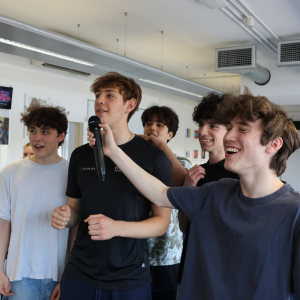
 As summer approaches, most students will be released from a consistent phone-free environment. In support of our families and how their children engage with tech outside of school, Halcyon hosted a virtual Digital Wellbeing Workshop for Parents and Carers covering topics like: AI companions, pornography, looksmaxxing, influencers, and relationships. Halcyon’s Digital Learning Coach emphasised our ongoing commitment to helping students navigate the digital world responsibly. Again, this isn't just about rules, it's about balance.We deliberately chose the last five weeks of school to try this, as it allows us, and our students, to ease into this cultural change. Most notably, implementing this policy in the weeks leading up to summer also allows us to gather real information and feedback from students, parents and staff before we adjust and re-implement come September.Just one week in, students have already provided Halcyon staff with feedback. One student praised the newly introduced activities stating, “I like it at lunch and break – that people are actually talking to each other and not just looking at phones.” While another recognised that the policy would take some getting used to noting, “between classes it’s just hard not being able to check [digital] schedules.”Students appear cautiously optimistic for change and for the opportunity to try different activities, filling our hallways with a bit more laughter, uninterrupted conversation, and a renewed sense of shared community that a screen simply cannot replicate.It is critical to note: This is not a response to a crisis. It is an investment in presence. Halcyon’s strength has always been our community and relationships – this is us leaning into that. Moving forward, we will continue to work comprehensively to ensure that our community remains actively involved as we co-create a healthier, more balanced blueprint for the future of students’ digital learning.

Subscribe to Relocate Extra, our monthly newsletter, to get all the latest international assignments and global mobility news.Relocate’s new Global Mobility Toolkit provides free information, practical advice and support for HR, global mobility managers and global teams operating overseas.
Visit Halcyon London International School's Featured School page
Read more Guide to International Education & Schools articles

Find out more about the Think Global People and Think Women community and events.
Subscribe to Relocate Extra, our monthly newsletter, to get all the latest international assignments and global mobility news.Relocate’s new Global Mobility Toolkit provides free information, practical advice and support for HR, global mobility managers and global teams operating overseas.
©2026 Re:locate magazine, published by Profile Locations, Spray Hill, Hastings Road, Lamberhurst, Kent TN3 8JB. All rights reserved. This publication (or any part thereof) may not be reproduced in any form without the prior written permission of Profile Locations. Profile Locations accepts no liability for the accuracy of the contents or any opinions expressed herein.