The Great Defence Reallocation
Rising defence spending is expected to boost demand for industrial, logistics and specialist office space, particularly in regional defence hubs, as investment shifts towards domestic manufacturing, technology and infrastructure.
16 November 2026
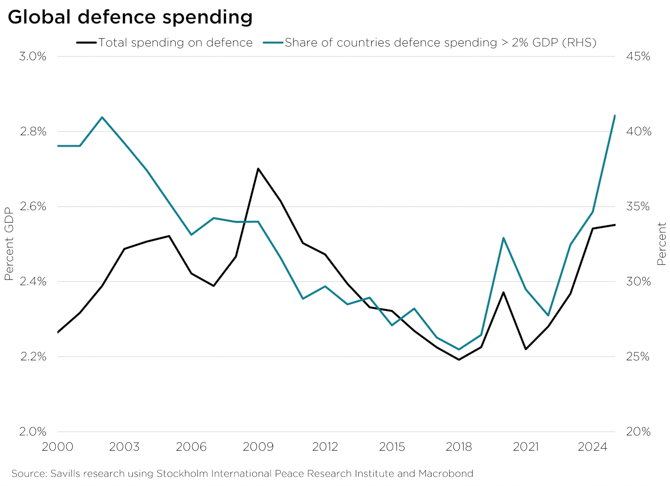
Global defence spending has seen several years of strong growth, as governments respond to a more fragmented geopolitical backdrop while simultaneously reassessing long-held assumptions around collective security. This trajectory looks set to continue, reinforced by NATO allies’ 2025 Hague commitment to raise defence spending to 5% of GDP by 2035.The economic impact is clearly not the primary objective. But it matters when thinking about the implications for real estate. And ultimately, that impact is likely to be smaller than the headlines suggest.
For many governments, higher defence spending requires compromises elsewhere. High-debt, high-deficit economies have limited room to fund additional commitments without raising taxes or cutting other spending. Meanwhile, economies already operating close to capacity face a different constraint. Additional demand is more likely to fuel inflation as the defence sector competes for scarce labour and other resources. In both cases, deficit-funded spending risks pushing up prices and interest rates, crowding out private-sector activity. Defence spending also tends to have a relatively low economic multiplier. Personnel and operational costs absorb a substantial share, while many countries import much of their equipment and munitions.
Yet there are several reasons to think this cycle could be different. A sustained, investment-led increase in spending has greater potential to generate lasting economic gains. The recent expansion in military capacity has been more capital-intensive, consistent with historical periods of non-wartime spending, while technological change is necessitating increased investment in equipment, infrastructure, innovation and R&D. The sharp rise in VC funding for defence start-ups is one sign of this shift. The broader economic story, however, will be one of reallocation and redistribution. For real estate, this redistribution matters more than the headline impact on GDP. As capital and production move between sectors and geographies, so will demand for space.
The clearest effects will be in industrial and logistics. Strategic autonomy will lead to greater emphasis on domestic production, while supply chains will need to adapt to shifting global alliances. Expanding manufacturing and rebuilding inventories will require additional industrial and storage capacity for components, equipment and munitions. Some of that capacity could come from converting facilities and redeploying workers from industries facing structural pressures.
Demand will also be redistributed geographically. Defence is highly concentrated around established clusters of skilled labour, specialist suppliers and secure infrastructure, many located outside the gateway cities traditionally favoured by institutional capital. Employment growth could shift housing demand towards these mid-sized cities, creating opportunities in residential and social infrastructure.
A similar dynamic may emerge in offices. Growth in cybersecurity, software, technical and support roles could benefit self-contained suburban offices and business parks, particularly where security requirements make conventional space less suitable.
Taken together, this could direct demand towards property types and locations that have fallen out of favour in an increasingly selective market, including secondary logistics locations, suburban offices and mid-tier cities.
The investable opportunity, however, will remain narrower than the shift in occupier demand suggests. Major defence contractors can offer strong covenants, long leases and government-backed revenues, while greater regulatory clarity around the compatibility of defence investment with existing ESG frameworks may widen institutional participation. But bespoke specifications create reletting and residual-value risks, and national-security considerations may restrict third-party ownership of sensitive assets.


Subscribe to Relocate Extra, our monthly newsletter, to get all the latest international assignments and global mobility news.Relocate’s new Global Mobility Toolkit provides free information, practical advice and support for HR, global mobility managers and global teams operating overseas.
For many governments, higher defence spending requires compromises elsewhere. High-debt, high-deficit economies have limited room to fund additional commitments without raising taxes or cutting other spending. Meanwhile, economies already operating close to capacity face a different constraint. Additional demand is more likely to fuel inflation as the defence sector competes for scarce labour and other resources. In both cases, deficit-funded spending risks pushing up prices and interest rates, crowding out private-sector activity. Defence spending also tends to have a relatively low economic multiplier. Personnel and operational costs absorb a substantial share, while many countries import much of their equipment and munitions.
Yet there are several reasons to think this cycle could be different. A sustained, investment-led increase in spending has greater potential to generate lasting economic gains. The recent expansion in military capacity has been more capital-intensive, consistent with historical periods of non-wartime spending, while technological change is necessitating increased investment in equipment, infrastructure, innovation and R&D. The sharp rise in VC funding for defence start-ups is one sign of this shift. The broader economic story, however, will be one of reallocation and redistribution. For real estate, this redistribution matters more than the headline impact on GDP. As capital and production move between sectors and geographies, so will demand for space.
The clearest effects will be in industrial and logistics. Strategic autonomy will lead to greater emphasis on domestic production, while supply chains will need to adapt to shifting global alliances. Expanding manufacturing and rebuilding inventories will require additional industrial and storage capacity for components, equipment and munitions. Some of that capacity could come from converting facilities and redeploying workers from industries facing structural pressures.
Demand will also be redistributed geographically. Defence is highly concentrated around established clusters of skilled labour, specialist suppliers and secure infrastructure, many located outside the gateway cities traditionally favoured by institutional capital. Employment growth could shift housing demand towards these mid-sized cities, creating opportunities in residential and social infrastructure.
A similar dynamic may emerge in offices. Growth in cybersecurity, software, technical and support roles could benefit self-contained suburban offices and business parks, particularly where security requirements make conventional space less suitable.
Taken together, this could direct demand towards property types and locations that have fallen out of favour in an increasingly selective market, including secondary logistics locations, suburban offices and mid-tier cities.
The investable opportunity, however, will remain narrower than the shift in occupier demand suggests. Major defence contractors can offer strong covenants, long leases and government-backed revenues, while greater regulatory clarity around the compatibility of defence investment with existing ESG frameworks may widen institutional participation. But bespoke specifications create reletting and residual-value risks, and national-security considerations may restrict third-party ownership of sensitive assets.
Find out more about the Think Global People and Think Women community and events.
Subscribe to Relocate Extra, our monthly newsletter, to get all the latest international assignments and global mobility news.Relocate’s new Global Mobility Toolkit provides free information, practical advice and support for HR, global mobility managers and global teams operating overseas.
©2026 Re:locate magazine, published by Profile Locations, Spray Hill, Hastings Road, Lamberhurst, Kent TN3 8JB. All rights reserved. This publication (or any part thereof) may not be reproduced in any form without the prior written permission of Profile Locations. Profile Locations accepts no liability for the accuracy of the contents or any opinions expressed herein.