What next for DE&I – the panel discussion
With the pushback from the government in the United States and elsewhere, Diversity, Equity and Inclusion legislation has become controversial in some circles recently. Marianne Curphey reports from the CIPD Annual Conference.
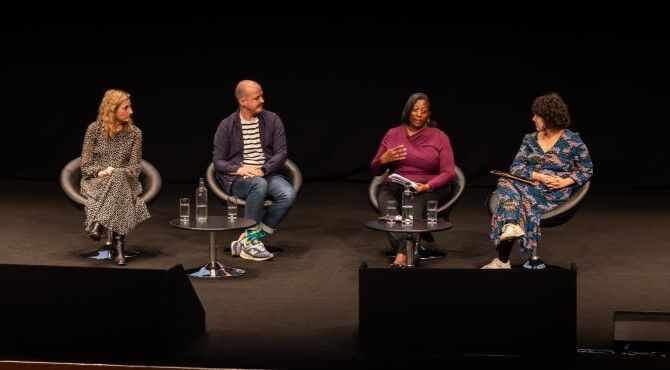
Panel at the 2025 CIPD Annual Conference – (left to right) Jo Carlin, Matt Davies, Cheryl Samuels & Katie Jacobs.
9 December 2025

View your copy of the Winter 2025/26 issue of Think Global People magazine
Click on the cover to access the digital edition.
With the pushback from the government in the United States and elsewhere, Diversity, Equity and Inclusion legislation has become controversial in some circles recently. A panel discussion with Cheryl Samuels, People & Culture Director at Evelina London (part of Guy’s and St Thomas’ NHS Foundation Trust); Jo Carlin, Chief People Officer at Effective Energy Group; Matt Davies, CEO at Hapus People and Katie Jacobs, journalist, author of the recent CIPD report on the future of EDI, looked at how this was impacting HR professionals in their roles in organisations.Describing DE&I as “a particularly hot topic”, Jacobs noted how “there will be organisations here dealing with the fallout of leaders retreating from DE&I”.“It is something that can be hard to keep on the agenda in financially challenging times when you've got lots of other priorities looking for space or dealing with employee concerns, however misplaced, about EDI efforts undermining the concept of meritocracy,” she said. “Questions over business value, outcomes, complexity, politicisation, changing language and confusion over legalities have all been making this space an increasingly challenging one for those that work within the profession.”However, on a more positive note, she pointed out that in the UK the majority of the British public does remain in favour of DE&I, with 48 per cent of the British public saying they believe that ED&I is a very good use of money and leads to fairer outcomes.
Read related articles
- From powerful conversations to practical change, Findings of Think Global Women 2025
- Driving change: Growing women in leadership
- The shape of mobility to come: strategy, technology, and leadership in a disrupted world
- Equity, diversity and inclusion: terminology and implications
Carlin said that one of the issues was that in order for DE&I to work, other people had to “give up seats”, something they were often reluctant to do, and that recently some had been more vocal about their opposition.“We can't have a diverse board if the board is still in place for 10 or 20, years, and yet the backlash has never really gone away,” she said.Davies pointed out that DE&I was not just “nice to have”, it was essential to business performance, although currently, there was an unfortunate “polarisation and dehumanisation of people who are different to us.”Samuels explained that the NHS was underpinned by its Constitution and the importance of healthcare being free at the point of need.“I feel strongly around it being free for all,” she said. That means being free to everyone, regardless of their background, creed or religious persuasions or sexual orientation.“That guiding principle grounds us as healthcare professionals, or professionals that sit within the NHS, around thinking about how we deliver healthcare equitably to everybody that needs it.”For example, she cited how black women were four times more likely to die in childbirth than white women, and that since breast cancer presents at a younger age in black women, it was often missed.
Looking at building workplaces for the future
Overall, the CIPD conference looked at ways to create a workforce that was psychologically safe for its employees, gave equal opportunity to people of all backgrounds, and was able to forge a productive and healthy relatiaconship between people and machines. As Harris told her audience, now is an important time to think carefully about the role of AI and technology in our lives. We have the responsibility to create a future where human skills are valued and are used to augment functions that AI cannot perform on its own.

Find out more about the Think Global People and Think Women community and events.

Subscribe to Relocate Extra, our monthly newsletter, to get all the latest international assignments and global mobility news.Relocate’s new Global Mobility Toolkit provides free information, practical advice and support for HR, global mobility managers and global teams operating overseas.
©2026 Re:locate magazine, published by Profile Locations, Spray Hill, Hastings Road, Lamberhurst, Kent TN3 8JB. All rights reserved. This publication (or any part thereof) may not be reproduced in any form without the prior written permission of Profile Locations. Profile Locations accepts no liability for the accuracy of the contents or any opinions expressed herein.