AI integration the processes, pitfalls and the roadmap for successful integration
AI is changing the nature of jobs, workflow and efficiency, but also presenting huge challenges around employee upskilling and the impact on graduates and young people at the early stage of their career.
23 November 2026
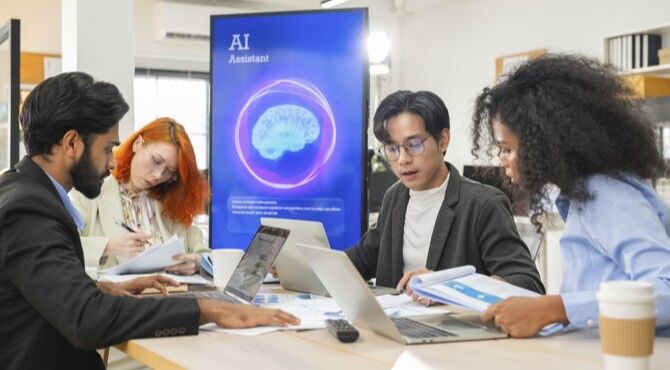
Priya Lakhani, founder and CEO of Century Tech, discussed ways of estimating the benefits of AI adoption. Her talk Building skills, culture and confidence in the age of AI at the CIPD annual conference looked at how AI could aid predictions around business strategy and make the workplace more productive, but that each business needed to think about the personalisation of AI integration and whether employees had the right skills.“AI is an objective crystal ball with your big data set to predict what happens in the future,” she explained. “Of all the goals that you need to achieve in the business and the problems you need to solve, where can AI help you?”She explained that return on investment (ROI) in AI integration was “extraordinarily easy to measure badly”. Businesses might talk about pilot projects that they have done, hours that have been saved and workflows that have changed, but this was meaningless unless they had a direct effect on the bottom line of the business.“You need to point every implementation to an actual business outcome that matters for your organisation,” she said. “Did it increase revenue? Did it increase our margins? What did you actually do with the 50,000 hours that you saved? Did you make fewer errors? Are there less shortages if you're in supply chain? Is there less overtime? Did you serve more customers? Did you grow revenue?”

Subscribe to Relocate Extra, our monthly newsletter, to get all the latest international assignments and global mobility news.Relocate’s new Global Mobility Toolkit provides free information, practical advice and support for HR, global mobility managers and global teams operating overseas.
How to manage successful AI integration
The importance of measuring AI’s effectiveness, rather than just using it as a time saving method, was the theme of a number of case studies where leaders explained the planning and execution of new AI projects. While AI can be used to reduce mundane tasks, enhance human performance, and improve productivity, each organisation will have different priorities. In the panel discussion: Practical Solutions for Digital Transformation, experts looked at how to use AI and tech to transform the workplace.The panellists were Ria Davey, Group Director-AI Workforce Transformation at the London Stock Exchange Group (LSEG) and Gareth Neale, Head of HR at Crimson Hotels. The panel was chaired by Stephen Pobjoy, Senior Stakeholder Lead at the CIPD. Both speakers cited challenges around the adopting of AI, including the need to ensure employees understood the process.Gareth Neale outlined the shift from paper-based, disconnected HR operations to integrated systems and streamlined workflows in a hotel chain which has multiple sites and employees from a variety of different cultures and nationalities.Delegates heard how AI and emerging technologies were redefining how organisations operate and how work gets done. AI applications included recruitment, onboarding, communications, translation, employee relations, policy updates, learning, analytics, and planning. He explained how the organisation also prioritised the principle of protecting sensitive information and maintaining human decisions.“One of our values is empower our people, and for me, it was critically important that we empower our managers to be able to make decisions,” he said. “We took a consultative approach. We talked to leaders of the business. What would make their lives easier? What would enable them to be successful? What would enable their teams to be successful? A key part of that was upskilling people along the way.”Equally important was choosing the right partner to provide new digital and AI services, and proper due diligence was necessary to ensure that security of information was maintained.“I had a call with a digital provider at which I stopped after ten minutes because I asked them the question, "How do you store your data?" and frankly, their answer sounded like they just left it lying around. It's totally unacceptable. The security of data is really critical,” he said.Crimson Hotels has begun using AI to screen responses to job advertisements, which often attracts 300 candidates per job. AI was able to help reduce these to a short list, and it was also helpful in writing job advertisements.The process also involved reviewing strategy and workforce planning, looking at succession plans, the talent pipeline, and how roles and skills might change and develop in the future. Unlike some highly regulated industries, Crimson Hotels did not need to have a very strict internal policy on AI use.“We have had some key principles but we don't have a very strict policy,” he explained. “A lot of businesses will have a seven-page document that says exactly what you can and can't do. We want to empower people to use the technology, but to use it responsibly. The key thing we have said is no personal, commercially sensitive, or confidential information should be shared with with AI.”Related reading
- Practical ways to succeed with AI adoption
- Effective change management – case studies from the front line of industry
- Cultivating a success mindset and leading in an uncertain world
- These times of risk and uncertainty call for bold leadership, CIPD delegates told at annual conference
- New ways of thinking – how creating wealth for the economy and managing change and transition starts with effective people skills and policy change
How regulated organisations tackle the AI challenge
By contrast, LSEG is highly regulated by financial services regulators and needed to have a more extensive policy on AI use. LSEG is a financial global financial services firm with over 30,000 employees across 60 countries, 43,000 customers and generated about £9 billion income in 2025. It provides data and analytics, clearing services, risk, and other consultancies to some of the world's largest banks, asset managers and traders.As part of the process of analysis, LSEG deconstructed the business partner role into 55 tasks and identified opportunities for AI to assist or remove work. It precipitated a shift towards automating some tasks via AI, and building human skills in judgment, problem-solving, collaboration, and continuous learning.Ria Davey described it as the WORK framework: workflows first, omit unnecessary steps, reassign tasks, and retain human judgment where knowledge and governance matter. She said the pace of change was so fast that most organisations did not feel that they were ahead of the game, and that AI was being used in new and extensive ways.“You have moved from agents and augmentation coming into the organisation to help you with personal productivity, to agents entering workflows with a lot of frontier organisations deploying fleets of agents to run their businesses now.”One challenge LSEG needed to plan for was how fast things are transforming now and what the workplace could look like in the future.“On top of all that, obviously we have got a big VUCA environment that we are all dealing with from a financial services standpoint, as LSEG is very much at the heart of business and trade,” she said. “So any of the geopolitical issues that come will impact our business. We are very focused on the pressures that are impacting our businesses and our workforce, and are therefore redesigning work, building skills, and really embedding that human accountability. The approach that we took as an organisation is really focusing on product-led and what our customers want.“The key thing for us is how is the financial services sector and our clients' workflows changing themselves?” she said. “How are they using us and our data now, and how do we predict it in the future? We have gone from traders, for example, who would use enormous amounts of data across various different segmented systems to collate their information and make a buy, sell, recommendation, to actually getting that information instantly and asking for the answer, so they are not even doing the analysis. We have also gone from those clients that are personally dealing with us humans to actually having their agents dealing with us, and those agents knowing them better than we could ever know, and hyper personalisation. In addition, we have got lots of clients with fleets of AI agents that are going throughout their workflow.”She said that analysing workflows gave LSEG the opportunity to look at where there an opportunity for AI to assist, and what really remains uniquely human.“Humans are more important than ever in an AI agentic organisation,” she said. “As AI takes on the routine work, we are deliberately redesigning work based upon the deconstruction of roles and workflows into tasks. We are looking to scale across the organisation those uniquely human skill sets including collaboration, problem solving, strategic thinking, judgment, and continuous learning.”She said unfortunately the impact was likely to be a shift in the business which would create “an hourglass organisation shape, which really pinches at the middle and changes that role of the middle managers.”She described the workplace of the future as a connected organisation with AI agents at the bottom, which she said raised questions around how graduates and early career employees fit into the organisation.“It changes the role of the leader as well, from really focusing on coordinating tasks and processes to using their judgment and pivoting strategy very quickly.”Overall, both panellists described a future where AI is a collaborator, not just a tool, and human skills will be amplified around strategy and problem solving.About the CIPD Annual Conference and Exhibition (ACE)
The CIPD Annual Conference and Exhibition was held at Manchester Central on 4 and 5 November. The event will bring together people professionals, business leaders and experts to examine how employers can respond – sharing evidence, practical experience and innovative approaches with real-world impact.Keynote speakers this year include Octopus Energy founder and CEO Greg Jackson; leadership expert and London Business School Charles Handy Professor of Organisational Behaviour Herminia Ibarra; performance psychologist and high-performing teams expert Jamil Qureshi; and AI entrepreneur Priya Lakhani OBE.See more on LinkedIn: https://www.linkedin.com/company/cipd/posts/?feedView=allRead CIPD's day one coverage on People Management: https://www.peoplemanagement.co.uk/article/1974412/cipd-annual-conference-exhibition-2026-highlights-day-one#CIPDACE
Find out more about the Think Global People and Think Women community and events.
Subscribe to Relocate Extra, our monthly newsletter, to get all the latest international assignments and global mobility news.Relocate’s new Global Mobility Toolkit provides free information, practical advice and support for HR, global mobility managers and global teams operating overseas.
©2026 Re:locate magazine, published by Profile Locations, Spray Hill, Hastings Road, Lamberhurst, Kent TN3 8JB. All rights reserved. This publication (or any part thereof) may not be reproduced in any form without the prior written permission of Profile Locations. Profile Locations accepts no liability for the accuracy of the contents or any opinions expressed herein.