These times of risk and uncertainty call for bold leadership, CIPD delegates told at annual conference
Organisations that will succeed in the age of Artificial Intelligences are those that take bold decisions but put people at the centre of their strategy, speakers at the conference in Manchester were told.
5 November 2026
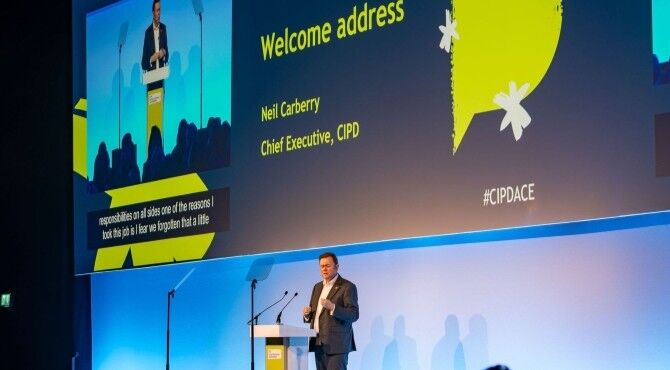
Business performance is about having great people, even in the age of AI, and taking action to create great organisations even when the challenges we face are new and frightening.In his first conference as the new chief executive of the CIPD, Neil Carberry unveiled a roadmap for HR professionals to navigate the “scary and new” world they now work in.“The first priority is building workplaces that perform, because everything else can flow from that,” He said. The second is “Building the skills within the profession that help us achieve that” and the third is “owning the future solutions with confidence”.Carberry leads the CIPD, the professional body for HR and people development, after succeeding Peter Cheese, who led the CIPD for 14 years.Carberry said it was a privilege to lead the CIPD at “a moment of profound challenge and opportunity”.“I know that we are all sick of hearing that the world is changing all around us,” he said. “But it is. At a faster pace than any of us have known. We can choose to be buffeted by that change or to lead through it.”

Subscribe to Relocate Extra, our monthly newsletter, to get all the latest international assignments and global mobility news.Relocate’s new Global Mobility Toolkit provides free information, practical advice and support for HR, global mobility managers and global teams operating overseas.
Preparing for an uncertain future
Among the key themes of the CIPD’s annual conference was the question of how to prepare for this new world – from building teams, showing leadership, and developing new skills.“How you manage people is a question of vital organisational performance, not only morality,” Carberry explained. “Performance is not something you extract from people. It is something you build with them. Performance depends on individual contribution, but also on the relationships, management and shared purpose that enable people to achieve more together.”He acknowledged that in a new working world employers have the right and the responsibility to be clear about what their organisations need, and that delivering performance is an essential part of business strategy. He emphasised, however, that workers have a voice that must be heard, and sometimes there can be disagreement or discomfort.“The test is whether we have the evidence, judgement and trust to handle conflict well — and make decisions that improve both performance and the working experience for everyone,” he said. “Without grit we would have no pearls. But to secure the pearls, we have to be willing to work with the grit.”He described how a world of changing technology, demographics, and economic pressures are transforming the way we work, the work that is done, and the people needed to do it.“We have faced economic shocks, the march of AI, supply-chain crunches, workforce change, rising costs and a roller coaster of political upheaval,” he said. “Employers trying to navigate all of this while remaining competitive and meet the expectations of their customers and employees are uncertain and cautious.”Related reading
- CIPD Annual Conference and Exhibition (ACE) 2026
- Early careers and future-proofing talent pipelines
- The risk isn't the global mobility industry changing - it's us not changing with it
- Managing in a VUCA world
- The Future of Work: Cultivating Innovation and Powering Discovery
The need for resilient leadership
Recent economic and geopolitical events have showed that organisations have new challenges to face.“Frankly - risk is back,” Carberry said. “From 1992 until 2008 the economy grew steadily. From 2008 until 2022 lending was close to free so employers and households could cope with headwinds. Now, we are back to a more normal world. One which requires a different sort of leadership.”In this new environment, leaders needed to make decisions that might not always be right, and will need to adapt to change and build resilience.This type of leadership needs to be able to “take the big calls based on the best information they have, hoping to be generally right even if they are specifically wrong,” he said.Being able to achieve this is not just good for individual companies, but helps to support the economy as a whole.“Successful workplaces mean we can raise living standards, invest in public services, build railways, create opportunities. They give people more confidence about the future and a better chance to build the lives they want. And when growth is weak, those opportunities fade.”“Young people at precisely the moment when they should be developing skills, discovering their strengths, building their confidence, are instead at risk of becoming disconnected from all those experiences,” he said. “That should concern every one of us.”He called on the government to put people, skills and participation at the heart of the growth agenda, and recognised that having a capable and skilled workforce should be at the heart of economic strategy.The problems facing today’s leaders
Carberry argued that many of the issues the worry chief executives, especially around business performance, workplace skills, a sustainable culture and the use of new technology, all have “a significant people component at the heart”.He said these were critical questions that determined the success of an organisation and said chief executives and boards needed to view workforce and culture as drivers of performance, not just cost.Keynote speaker Jami Qureshi, a performance psychologist who has worked with top sports players, discussed how to build high performance teams for organisational success. He explained how creating a mindset for success can lead to different outcomes, and creating a culture that is about discovery as well as knowing can help to future proof a business in a world that is changing fast.As AI integration is now a hot topic in many businesses, the CIPD conference also heard case studies of how AI adoption had been introduced successfully in different organisations, and how approaches can vary depending on the size, structure, resources and digital maturity of the business.The closing keynote speaker of the day, Priya Lakhani, founder and CEO of Century Tech, discussed how to measure return on investment in AI introduction and integration. Her talk: Building skills, culture and confidence in the age of AI looked at how businesses can navigate disruption and build a culture of innovation.About the CIPD Annual Conference and Exhibition (ACE)
The CIPD Annual Conference and Exhibition is being held at Manchester Central on 4 and 5 November. The event will bring together people professionals, business leaders and experts to examine how employers can respond – sharing evidence, practical experience and innovative approaches with real-world impact.Keynote speakers this year include Octopus Energy founder and CEO Greg Jackson; leadership expert and London Business School Charles Handy Professor of Organisational Behaviour Herminia Ibarra; performance psychologist and high-performing teams expert Jamil Qureshi; and AI entrepreneur Priya Lakhani OBE.See more on LinkedIn: https://www.linkedin.com/company/cipd/posts/?feedView=all#CIPDACE
Find out more about the Think Global People and Think Women community and events.
Subscribe to Relocate Extra, our monthly newsletter, to get all the latest international assignments and global mobility news.Relocate’s new Global Mobility Toolkit provides free information, practical advice and support for HR, global mobility managers and global teams operating overseas.
©2026 Re:locate magazine, published by Profile Locations, Spray Hill, Hastings Road, Lamberhurst, Kent TN3 8JB. All rights reserved. This publication (or any part thereof) may not be reproduced in any form without the prior written permission of Profile Locations. Profile Locations accepts no liability for the accuracy of the contents or any opinions expressed herein.