Global businesses risk losing growth opportunities as CFOs sidelined on crucial investment and value decisions
Companies worldwide risk missing vital growth opportunities because their CFO’s ambition to lead key investment and value creation discussions is hampered by a lack of readiness to use technology, and a dearth of skills across the wider finance team, according to the latest EY Global DNA of the CFO survey.
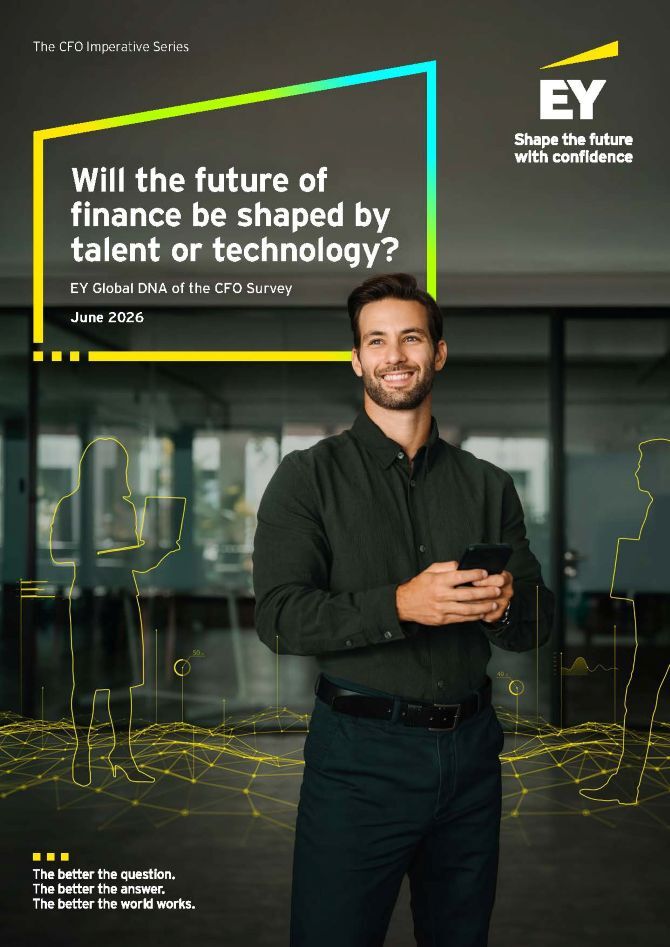
Image credit: EY Global
8 June 2026
- 60% of CFOs say they want to lead on value creation, but only 25% front vital investment decisions and just 26% lead value creation discussions
- 68% say definition of enterprise value must change
- Only 21% view their AI preparedness as leading or advanced while most still have only a limited grasp and they don’t yet see AI’s full potential
The challenge of measuring value
One of the key barriers to CFOs fulfilling their potential as value creators highlighted by the findings is the challenge of measurement. Half of all CFOs (49%) believe that traditional metrics cannot capture the value created by technology, data, new roles, or even long-term investments, while a similar percentage (50%) say that a big obstacle is the difficulty in proving ROI upfront. More than two thirds (68%) say that current metrics need to be redefined.Myles Corson, EY Global Strategy and Markets Leader – FAAS says:“CFOs, and finance teams in general, won’t be able to lead the charge on value creation, without a rethink in how value is measured.“The ways in which companies generate value are becoming ever more complex and new sources of value aren’t easily captured by traditional metrics. Without a clear framework to measure value in all its forms, CFOs will find it harder to assess where it is truly being created and won’t be well positioned to lead discussions or challenge decisions.”AI readiness
According to the survey, CFOs are also challenged in their efforts to transform by the lack of mindset and skills relating to new technologies across their teams. Only a fifth (21%) of CFOs feel that their finance function’s AI preparedness is leading or advanced, compared to other companies, and less than 15% believe their teams to be highly adaptable, or confident, using new technologies including AI.This lack of confidence appears to be limiting the extent to which CFOs use technology to inform high value decisions. The survey shows that less than half of CFOs see strong potential for AI in areas such as data analysis (49%), growth forecasting (45%), and dynamic pricing (41%). However, it is clear that CFOs who consider their teams to be more AI ‘ready’ are much more likely to see the full potential of AI in value creation: for example, almost three quarters (71%) of those who say they are fully prepared for AI believe it can play a role in growth forecasting.Finance teams also report a number of hurdles when it comes to securing investment for AI – 61% cite problems with data quality, 51% struggle to clearly explain the benefits, and 50% say they lack the necessary skills or capacity to make full use of the technology.Meg Paschall, EY Organization and Workforce Transformation Leader, says:“The survey findings highlight that finance functions are not yet ready to make the most of AI and other emerging technologies. Many organizations are still building the capabilities to produce and interpret insights and are not yet equipped to apply these insights to business-critical decisions. The question is not whether finance teams have access to technology but whether they have the mindset and skills to put it to good use.”Related reading
- How the financial services industry is responding to global change
- Future-proofing your organisation: the importance of measuring and defining culture
- The value of reward equity in international assignment compensation
The CFO skillset
Another fundamental challenge, underscored by the survey findings, is that leadership capabilities are not keeping up with the fast-changing demands of the CFO role. Almost two fifths (38%) of CFOs say they are evolving faster than their leadership teams across the wider finance function, and more than two thirds (68%) believe they need new skills and leadership styles if they are to remain effective. Half (50%) want leadership development to be available across the finance team, in order to prevent succession risks.Corson, says:“What’s clear from our latest survey is that the capabilities of finance teams are not keeping pace with the fast-evolving demands of the CFO role. CFOs are increasingly expected to operate as strategic leaders who can shape value and guide investment decisions but their ability to do this effectively depends on the strengths of the wider team.Paschall, says:“Without the right skills, finance teams will struggle to influence high‑stakes decisions, and the ability of CFOs to truly impact organizational progress will be limited. There’s also a very real risk that, if leadership skills across finance functions do not advance fast enough, future CFO talent pipeline won’t be as strong, placing the CFO role in jeopardy.”Steps CFOs can take
The report outlines a series of recommendations that can help CFOs to build resilient, innovative finance functions which serve as strategic partners to businesses:- Overhaul value measurement and take ownership of key investment decisions.
- Build AI readiness through strong data foundations and skills investment.
- Elevate people and culture as core priorities.
- Ensure adaptability, collaboration, and confidence with new technologies.
- Accelerate leadership development to strengthen succession pipelines.
- Redesign roles and operating models to free up time for value creation.
About the researchBetween 16 February and 30 March 2026, the global EY organization conducted research to understand the evolving role of the CFO. The research explored how CFOs can shape their roles to meet changing business requirements and deliver greater impact at personal, functional and enterprise levels. Through an anonymous online survey, responses were collected from 1,610 CFOs, Finance Directors, and Heads of Finance. The responses were weighted to ensure a geographically representative sample. Within the weighted sample, 33% of respondents were Group CFOs, Finance Directors or Heads of Finance, 34% were Divisional CFOs, Finance Directors or Heads of Finance and 33% were Regional CFOs, Finance Directors or Heads of Finance.Respondents were from 28 countries — 40% from the Americas, 35% from EMEIA and 25% from Asia-Pacific — and 22 industry segments. To participate in the survey, respondents were required to work for organizations with US$1b or more in annual revenue, total assets, assets under management (AUM) or gross written premiums. Respondents in the private equity sector had to work for a fund with at least US$250m in AUM.In addition, 16 in-depth qualitative interviews were conducted with CFOs from global organizations and EY subject-matter professionals. These interviews specifically explored the role of the CFO in relation to value creation, AI, finance transformation, personal development, and collaboration with the wider business. |
About EY
EY is building a better working world by creating new value for clients, people, society, and the planet, while building trust in capital markets.Enabled by data, AI and advanced technology, EY teams help clients shape the future with confidence and develop answers for the most pressing issues of today and tomorrow.EY teams work across a full spectrum of services in assurance, consulting, tax, strategy, and transactions. Fueled by sector insights, a globally connected, multi-disciplinary network and diverse ecosystem partners, EY teams can provide services in more than 150 countries and territories.All in to shape the future with confidence.EY refers to the global organization and may refer to one or more of the member firms of Ernst & Young Global Limited, each of which is a separate legal entity. Ernst & Young Global Limited, a UK company limited by guarantee, does not provide services to clients. Information about how EY collects and uses personal data and a description of the rights individuals have under data protection legislation are available via ey.com/privacy. EY member firms do not practice law where prohibited by local laws. For more information about our organization, please visit ey.com.This news release has been issued by EYGM Limited, a member of the global EY organization that also does not provide any services to clients.View the report here.

Find out more about the Think Global People and Think Women community and events.
Subscribe to Relocate Extra, our monthly newsletter, to get all the latest international assignments and global mobility news.Relocate’s new Global Mobility Toolkit provides free information, practical advice and support for HR, global mobility managers and global teams operating overseas.
©2026 Re:locate magazine, published by Profile Locations, Spray Hill, Hastings Road, Lamberhurst, Kent TN3 8JB. All rights reserved. This publication (or any part thereof) may not be reproduced in any form without the prior written permission of Profile Locations. Profile Locations accepts no liability for the accuracy of the contents or any opinions expressed herein.