Creativity as a competitive advantage
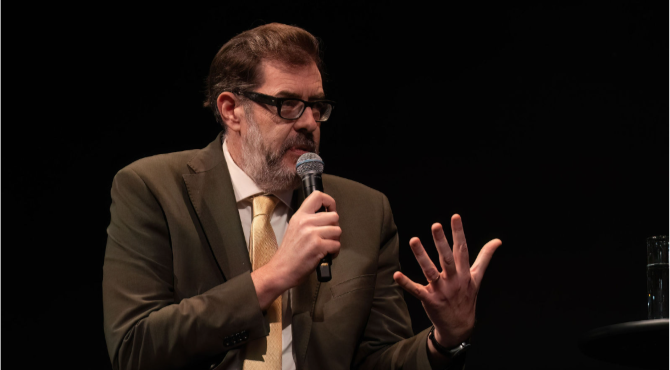
We went along to a fireside chat with author and broadcaster Richard Osman who shared some career lessons on creativity, courage and resilience at the recent CIPD Festival of Work.
14 July 2026
Reflecting on his career journey spanning television, writing and beyond. Osman spoke about his mid-life pivot, taking creative risks and the power of storytelling.“I would describe myself as an author, I would say. We always say the thing that we want people to see us as but that’s what I get recognised for most now. I would have been a TV presenter but now I think I’m an author. And then, I think I’m going to become a grime DJ. You’ve got to keep moving and surprising people don’t you?” he smiled. Talking to CIPD chief executive Peter Cheese, Osman shared some valuable lessons with a room full of people management professionals and business leaders.From humble beginnings, Osman discussed his career shaping moments to the importance of supportive, inclusive and diverse workplaces that allow people and ideas to thrive.“I came from a low income household. I knew nobody in the media and had no connections at all but I loved television. I loved drama. That was the world I was fascinated with. I would watch the credits on TV and wonder what everybody did. So that’s what fired me up. I did nothing at school that would’ve helped me with it at all but I knew in my heart it was what I wanted to do.”


Subscribe to Relocate Extra, our monthly newsletter, to get all the latest international assignments and global mobility news.Relocate’s new Global Mobility Toolkit provides free information, practical advice and support for HR, global mobility managers and global teams operating overseas.
On knowing your USP
After university, on the verge of taking a job in telesales, Osman saw an advert in the Guardian for a TV researcher and went for it.“At the interview, you’re probably not allowed to do this now, but the person said: I’m looking at your CV and I can see you went to Cambridge University. What on earth can someone who went to Cambridge University show someone who lives on a housing estate in Basildon? Luckily enough, I was able to say I was brought up in a housing estate in Billericay, just 5 miles from Basildon, so I think I’ll be OK. I got that job and never looked back.”But there was more to his story. Some might say courage, others might call it knowing your USP.“The whole point of the way I tried to go about the job is that I walked into an environment in the 90s which was very male, very white and very public school as a lot of the creative industries have been for a very long time. In that television environment, I realised very quickly that I was pretty much the only person there who actually watched TV. Who grew up with a TV in the corner of the room and with it being the social life of my whole family. I understood and knew every programme that had been on for the last 20 years. I knew what I liked. What worked and what didn’t work. It was in my DNA. I was also lucky to be able to rise fairly quickly because I was in the sort of job where you just have to have an idea. If you have an idea and someone makes it, that's the job done and I was in an environment where other people couldn't do that.”Read related articles
- Making modern work actually work
- Difference and collaboration take centre stage
- Resolving the most difficult workplace conversations
On creativity and AI
Osman talked about creativity as a skill that works outside of any system, that gives uniqueness and cannot be depleted.“You'll have these [types of creative] people in your organisation and these are the people in the next 10- 20 years who are going to be worth their weight in gold,” he added.Creativity is not about the new blockbuster thing that no one's ever thought of because those things don't exist, argued Osman. The real key to creativity? Looking around you, understanding that the world is changing, and taking two completely familiar things to create something in the middle which nobody has ever come up with to give your business an advantage.“The whole point of any sort of creativity – be that writing, acting or running a business – is you have to do the thing that’s unexpected and AI will always, always do the expected thing.”While that can be brilliant and useful, he added that competitive advantage in a fast-changing world comes from people who can adapt and approach things differently.“AI is going to be incredibly useful to you in lots of different ways but every single other competitor will have access to the same AI as you and they're likely doing the same thing. The absolute thing that's going to make a difference in your organisation is having that one person, or that one unit in an organisation, that goes: why don't we not do A, B, C, D why don't we do A, B, C, F?”On clarity and communication
Osman talked about the importance of language and communication at work and delivering it in a way that everybody can understand. His advice? Keep it simple and make it good.“It needs to feel utterly familiar because people have got to be able to hear it. It needs to be unexpected because people have got to remember it. I think it's simplicity multiplied by unexpectedness.”Thinking about communication in the workplace, Cheese and Osman discussed ways to improve communications and the importance of context. While Osman suggested having a more open-ended communication approach that is honest and invites people to engage, feedback and help find solutions together.“I always say, if you've got a problem with [something or] somebody, make it both your problem. You've got to say, listen, here's the new thing we've got to deal with. Has anyone got any suggestions?”On human connection and diversity
Osman later emphasised the importance of human interaction and connection, implying that people are yearning for human connection and “starved of community.”Organisations, and HR professionals in particular, often help provide that without realising it. “Connection – that’s all we want,” Osman continued. “Sometimes people don’t realise that what you do in an organisation is provide that”. That human connection will become even more important as AI becomes more capable, he added.Referencing the successful growth of television production company Endemol, he touched on the business and financial advantage of having a diverse workforce that represents your customers and the countries you work in.“I don’t need 50 other people who are like me. I need people to make shows I never would have thought of. I need people that have backgrounds that are different to mine. People who are brought up differently, use television differently and have heard different stories to me. Those are the people I needed and that’s how we grew that company. By having a group of people around the table that came from different places and did different things. I can’t think of a single business in the world that that does not apply to.”Richard Osman soundbite on failureRemember, almost everything fails. If you try anything, or you’ve got any sort of guts about you, you’re going to be trying new stuff all the time. Almost all of it fails but that’s OK because you only need some of it to work and when that something works it lasts forever. |

Find out more about the Think Global People and Think Women community and events.
Subscribe to Relocate Extra, our monthly newsletter, to get all the latest international assignments and global mobility news.Relocate’s new Global Mobility Toolkit provides free information, practical advice and support for HR, global mobility managers and global teams operating overseas.
©2026 Re:locate magazine, published by Profile Locations, Spray Hill, Hastings Road, Lamberhurst, Kent TN3 8JB. All rights reserved. This publication (or any part thereof) may not be reproduced in any form without the prior written permission of Profile Locations. Profile Locations accepts no liability for the accuracy of the contents or any opinions expressed herein.